

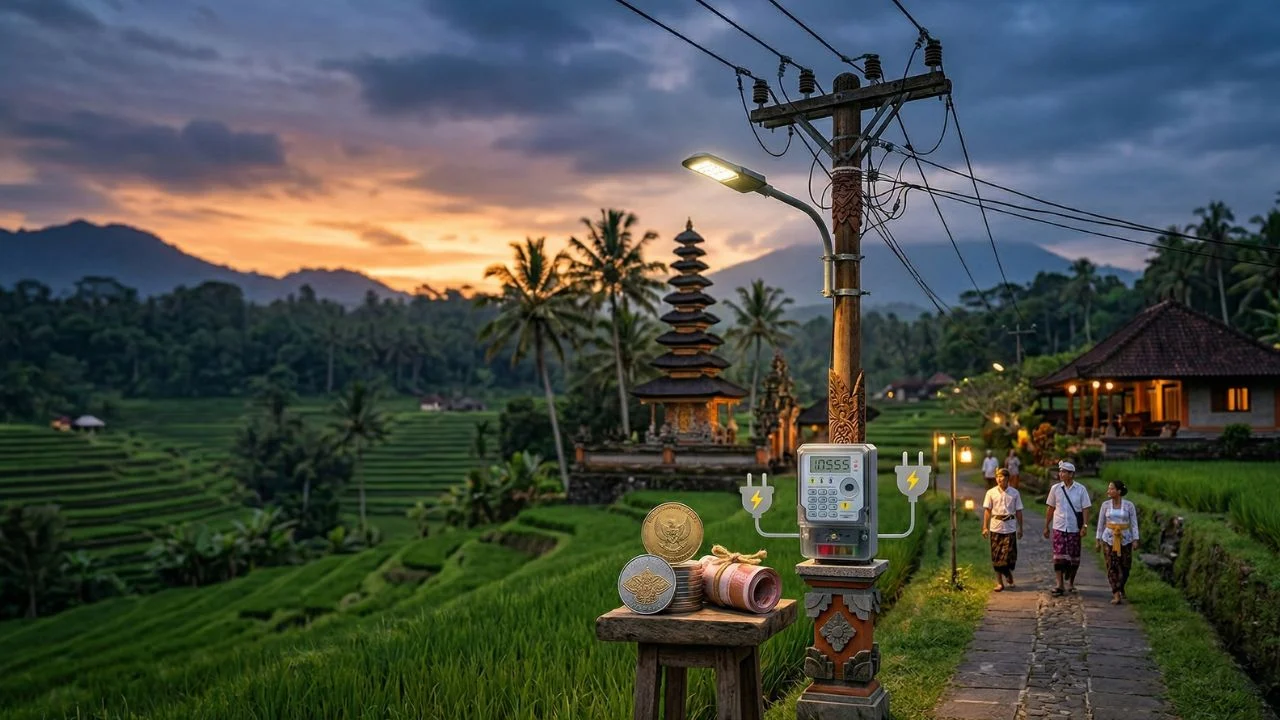
Hello everyone! Living in Bali feels like a vacation every day, right? From hanging out by Kuta beach, stylish coffee in Canggu, to enjoying the calm atmosphere in Ubud. But, behind the beauty of life on the Island of the Gods, there’s one reality that we can’t avoid every month: paying the electricity bill! Bali’s weather, which is often scorching hot, makes it really hard to let go of AC or fans. Not to mention for those of you who have businesses like guesthouses, villas, cafes, or food stalls. Electricity is definitely one of the biggest monthly expenses that must be calculated carefully. So, for those of you who are still confused or just want to update on the actual PLN electricity tariffs in Bali right now, you’re in the right article!
The good news in 2026 is that the government has announced that electricity tariffs for the first and second quarters (until June 2026) will not increase. So, you can breathe a little easier because the cost of living burden won’t skyrocket heading into mid-year.
As an important note, electricity tariffs in Indonesia are national in nature. That means, the tariff per kWh that applies in Jakarta, Surabaya, or Bali is the same, directly regulated by PLN and the Ministry of ESDM. The difference is only in the Street Lighting Tax (PPJ) whose percentage is determined by each regency/city government in Bali.
To make you even more understanding and not shocked when hearing the tit tit tit sound from the electricity meter, let’s thoroughly dissect the complete list of the latest 2026 electricity tariffs per kWh, using easy-to-understand language!
1. Household Group: Which Category Do You Fall Into?
This group is the most common and has the most customers. PLN divides household customers into two big camps: Subsidized (those who get government assistance) and Non-Subsidized (those who pay with normal tariffs).
A. Subsidized Household (To Keep Wallets Safe)
This is a special tariff given by the government for families who really need assistance. Usually, this group has small electricity power because the use of electronic devices is also limited (not using a lot of AC or water heater).
R-1/TR Group (450 VA Power): Rp 415 per kWh This is the smallest power. Usually used in simple row houses. With this much power, you can only turn on lights, TV, and maybe a small fridge or fan. If you turn on rice cooker together with an iron, get ready for the meter to snap!
R-1/TR Group (900 VA Subsidized Power): Rp 605 per kWh 900 VA power is quite comfortable, but those who get Rp 605 tariff are only those whose data is in the Integrated Social Welfare Data (DTKS).
B. Non-Subsidized Household (Normal Tariff)
Well, if your house has more than one AC, uses a water pump, has a front-loading washing machine, or water heater, you’re most likely in this group. Especially if you rent a house or live in commercial housing in Bali, almost certainly you use non-subsidized tariffs.
R-1/TR Group (900 VA RTM Power): Rp 1.352 per kWh RTM stands for Affluent Household. The power is the same 900 VA as above, but because it’s considered already affluent, the tariff is very different. The price is more than twice as much as the subsidized one!
R-1/TR Group (1.300 VA Power): Rp 1.444,70 per kWh This is the “million people” power for middle-class households or exclusive boarding houses in Denpasar. This much power is strong enough to run one 1/2 PK AC, fridge, TV, and washing machine at the same time.
R-1/TR Group (2.200 VA Power): Rp 1.444,70 per kWh The per kWh tariff is exactly the same as the 1.300 VA one. The difference is only in the power capacity. If your house is a bit big and needs to turn on 2 ACs at once, better upgrade to this power so you don’t often have blackouts due to overload.
R-2/TR Group (3.500 — 5.500 VA Power): Rp 1.699,53 per kWh For those of you who have big houses, medium-sized private villas, or families with many members where each room has AC, you fall into this elite group. The tariff is more expensive, guys!
R-3/TR Group (6.600 VA and up): Rp 1.699,53 per kWh This is the “sultan” class. Usually for super luxurious houses that have complete facilities like private swimming pools with big pumps, central AC, and high-power electric ovens.
2. Business Group: Attention for Entrepreneurs in Bali!
Bali is the paradise of UMKM and hospitality. From the end of Uluwatu to the end of Karangasem, it’s all businesses. PLN has special tariffs for places whose purpose is to make profit, aka commercial.
B-2/TR Group (6.600 VA — 200 kVA Power): Rp 1.444,70 per kWh This tariff is intended for shophouses, minimarkets, restaurants, guesthouses, or trendy coffee shops. Interestingly, the B-2 tariff price is exactly the same as household power 1.300 – 2.200 VA. So, for those of you who have a business, make sure the electricity is registered as a business group so it matches its purpose.
B-3/TM Group (Power over 200 kVA): Rp 1.114,74 per kWh This is for very large-scale businesses, like 5-star hotels in Nusa Dua, big beach clubs, or malls. Even though the power used is giant (using Medium Voltage), the per kWh tariff is actually cheaper because they are bulk customers aka buying in large quantities.
3. Industry Group: For Factories and Manufacturing
Although Bali is more famous for tourism, there are still industrial areas, garment factories, food processing, or ice factories that need super huge electricity.
I-3/TM Group (Power over 200 kVA): Rp 1.114,74 per kWh This tariff is aimed at medium-scale industry.
I-4/TT Group (Power over 30.000 kVA): Rp 996,74 per kWh This is for giant industries with High Voltage (TT). They get the cheapest tariff under a thousand rupiah per kWh because of their extraordinarily massive consumption scale.
4. Government Facilities and PJU (Public Street Lighting) Group
Have you ever wondered who pays for the electricity for the bright lights on Bypass Ngurah Rai or the lights in government offices? Of course, the regional government that pays PLN with the following tariffs:
P-1/TR Group (6.600 VA — 200 kVA): Rp 1.699,53 per kWh (Standard-sized government offices).
P-2/TM Group (Over 200 kVA): Rp 1.522,88 per kWh (Large-scale government offices).
P-3/TR Group (Special Public Street Lighting): Rp 1.699,53 per kWh. Fun fact: The cost for street lights is actually paid from the Street Lighting Tax (PPJ) which is always deducted every time we buy electricity tokens or pay postpaid bills, you know!
5. Social Services Group
In Bali, the role of banjars, temples, and orphanages is very strong. Facilities that are community service in nature get “friend prices” from PLN.
S-1/TR Group (450 VA): Rp 325 per kWh
S-1/TR Group (900 VA): Rp 455 per kWh
S-1/TR Group (1.300 VA): Rp 708 per kWh… – S-1/TR Group (2.200 VA): Rp 760 per kWh
You can see the difference, right? Temples, mosques, churches, or banjar halls with 1.300 VA power only pay Rp 708 per kWh, while regular houses have to pay Rp 1.444,70 per kWh. Half the price!
Illustration: Buy 100 Thousand Electricity Token, How Many kWh Do You Get?
Many people like to grumble, “Feels like just bought a token yesterday, why is it beeping again now?” So you don’t wonder and feel “cheated” by the meter, let’s do some casual calculations. Let’s take an example you’re a boarding student or renter in Denpasar with 1.300 VA power (Tariff: Rp 1.444,70 / kWh). When buying a token, your money doesn’t 100% become electricity, because there’s a Street Lighting Tax (PPJ) deduction. Suppose the PPJ in your area is 5%.
Here’s an easy way to calculate it:
Token price you buy: Rp 100.000
PPJ deduction (Example 5%): Rp 5.000
Net money for buying electricity: Rp 100.000 – Rp 5.000 = Rp 95.000
kWh amount received: Rp 95.000 divided by Rp 1.444,70 = Around 65,7 kWh
So, if you buy a 100 thousand token, the number that will add up on your meter is around 65,7. If your AC is on 10 hours a day and consumes around 1 kWh per hour, that means in a week your 100 thousand token will definitely be gone. Makes sense, right?
Smart Tips to Save Electricity Amid Bali’s Heat
So your monthly money doesn’t run out just feeding “electricity vampires”, try implementing these simple tips. They really affect expenses, you know!
Set AC Temperature Smartly Many people, when hot, immediately set the AC to 16 degrees with the fan on the highest. In fact, the AC compressor will work panting and consume extraordinarily large electricity power. Just set to 24 or 25 degrees Celsius. That temperature is enough to make the room cool and comfortable for sleeping, plus it makes the electricity bill drop drastically.
Regularly Clean AC (At Least Every 3-4 Months) Dirty and dusty AC filters make the air trapped. The machine has to work extra hard to cool the room. The harder the machine works, the greedier it sucks electricity. So, don’t be lazy to call an AC service technician!
Utilize Bali’s Natural Light Bali has a lot of sunlight. Open the curtains wide in the morning and afternoon. No need to turn on lights in the house if the sun is shining bright. Besides saving electricity, air circulation also becomes healthier.
Unplug Plugs That Aren’t Used Did you know that TVs, microwaves, or phone chargers that are still plugged into the socket even though not in use still suck electricity quietly? Although small, if collected in a month, it’s enough to buy several packs of nasi jinggo.
Switch to LED Lights If your house still uses old yellow incandescent bulbs or tube neon lights, better gradually replace all with LED lights. LED lights require far fewer watts but can give equivalent brightness, even brighter.
Conclusion
There you have it, the complete details of the latest PLN electricity tariffs for the Bali area (and all of Indonesia) in 2026. By knowing the per kWh tariff according to your home or business group, you can be wiser in managing budget and daily electronic usage. Remember, there are no tariff increases in the near future, but uncontrolled usage will still make your wallet burst.
So, after reading this article, do you have plans to start applying electricity-saving habits at home? Or do you need my help to calculate estimated monthly bills based on the electronic devices in your boarding house or villa? Feel free, just let me know!