

Hello! When talking about Bali, it feels incomplete to holiday on the Island of the Gods without stopping by its super aesthetic and magical temples. From Uluwatu Temple with its champion sunset and Kecak dance, Tanah Lot Temple which sits in the middle of the sea, to Lempuyang Temple which is super famous for the “Gate of Heaven” photo. All of them are definitely a must-include on your holiday itinerary.
But, there’s one really important thing that tourists, both local and international, often miss. Temples in Bali are not just regular tourist spots or historical museums. A temple is a very active sacred place used by Balinese Hindus for daily worship. So, the religious atmosphere is very strong.
Because this is a sacred place, there are automatically rules to follow, an etiquette that we absolutely must respect. Balinese people are very friendly and open (the concept of Tat Twam Asi — “I am you, you are me”). They are very happy for their temples to be visited. Provided that we, as guests, are self-aware and respect local customs. The saying goes, “When in Rome, do as the Romans do.”
So that your holiday goes smoothly, you don’t get scolded by Pecalang (traditional Balinese security officers), and you still get those positive vibes, let’s thoroughly discuss what the prohibitions and taboos are when visiting a temple in Bali. Let’s keep the language casual so it’s easy to understand!
Get to Know the Three Temple Zones (Tri Mandala)
Before getting into the prohibitions, you need to know a little about the architecture of Balinese temples. Temples are usually divided into three areas or courtyards, called Tri Mandala:
Nista Mandala (Outer Area): This is the outermost zone, usually a parking area, preparation area, or gathering place before events begin. The rules here aren’t too strict yet.
Madya Mandala (Middle Area): Upon entering here, you must start behaving respectfully and are required to wear proper clothing (using a sarong). Usually, there is a pavilion or hall here for prayer preparation.
Utama Mandala (Most Sacred/Inner Area): This is the core of the temple, where the pelinggih (shrines for God and ancestors) stand. The rules here are super strict, and generally, tourists can only view from the boundary of the Madya Mandala, unless you want to join in prayer or there is a specific ceremony.
Now that you know the zones, here is a list of prohibitions you absolutely must note:
1. Strictly Prohibited for Women Who Are Menstruating
This is rule number one and the most absolute. In Balinese Hindu belief, there is a concept called Cuntaka (a spiritually impure period). Menstrual blood is considered a form of cuntaka.
This does not mean menstruating women are physically dirty or being discriminated against, not at all. This is purely about maintaining spiritual energy (purity) in the temple area. The sacred energy inside the temple is believed to clash with cuntaka energy, which is believed to potentially cause negative spiritual effects, both for the temple itself and for the woman’s physical well-being (such as sudden dizziness or weakness). So, if you’re on your period, it’s best to postpone entering the temple area. Taking photos in the outer area or Nista Mandala is usually still safe, but always ask an officer first to be sure.
2. Prohibited from Wearing Revealing Clothes and Short Shorts (Must Dress Modestly)
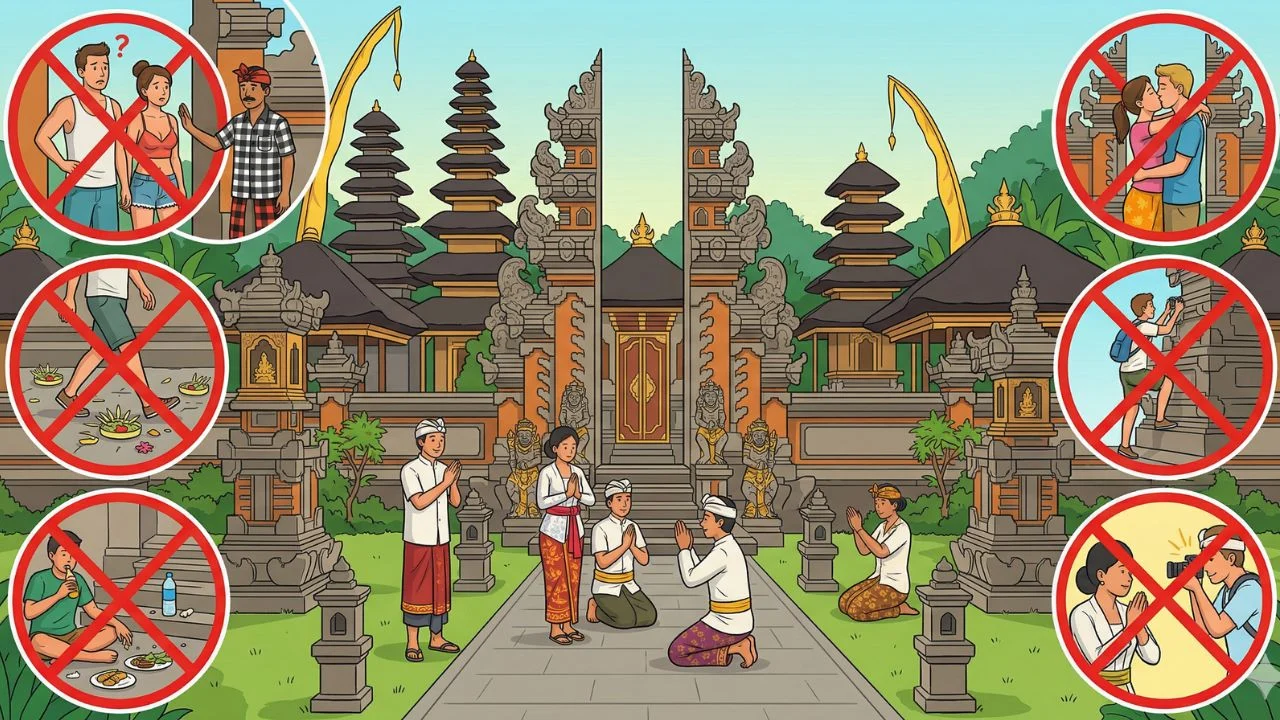
Going to a temple wearing a tank top, crop top, short shorts, or a swimsuit? Be prepared to be stopped at the entrance. Because this is a place of worship, clothing must be covered and modest.
Mandatory Dress Code:
Kamen (Sarong): Both men and women are required to wear a kamen that covers the legs down to the ankles (or at least below the knees). If you don’t bring one, don’t worry, almost all tourist temples rent or lend these cloths for free at the ticket booth.
Selendang (Sash): This is also mandatory. The sash is tied around the waist. It has a cool meaning: symbolically binding bad intentions and desires to remain below (stomach down), so our minds stay pure when entering the sacred place.
Closed Top: Try to wear a shirt that covers the shoulders. If wearing sleeveless, it’s better to use a jacket or cardigan while inside the temple.
3. Prohibited from Displaying Affection (No PDA – Public Display of Affection)
For those on a honeymoon or traveling with a partner, hold back the urge to show off your affection. Holding hands might still be tolerated in the outer area, but if you’re hugging affectionately, especially kissing on the lips within the temple area, it is strictly forbidden and considered a desecration of the place’s sanctity. The temple is a place to focus the mind on God, not a place for dating.
4. Prohibition for Those in Mourning (Recent Family Death)
Still related to the Cuntaka concept above. If you have an immediate family member (parent, child, sibling) who has recently passed away, you are also considered to be in a period of cuntaka. Usually, this mourning period has a specific duration according to custom before a person is considered spiritually “clean” and allowed to re-enter temples. So if you have recently lost a family member, it is best to avoid entering the main temple area to respect this tradition.
5. Prohibited from Speaking Harshly, Swearing, and Quarreling
Watch your speech and emotions! Sometimes Bali’s weather is very hot, the traffic is jammed, and by the time you reach the temple, you feel like getting angry. But remember, hold your emotions back. Uttering dirty words, swearing, or getting into verbal fights inside the temple is highly taboo. Hindus greatly maintain harmony and positive energy in sacred places. Harsh words are believed to pollute the temple’s positive vibrations. If you’re in a bad mood, it’s better to have a coconut drink outside first until you calm down, then enter.
6. Do Not Carelessly Step Over or Step On Canang Sari
You’ve probably often seen small woven palm leaf trays containing colorful flowers and incense in Bali. Those are called Canang Sari, a form of offering by Hindus. In the temple, these offerings are everywhere: on the ground, on stairs, on statues.
Please watch your step. Don’t intentionally step on or step over a canang. What if you accidentally step on it? It’s okay, accidents happen. Just silently say “Sorry,” and be more careful. But if you intentionally kick or step over it after seeing it, that is very disrespectful.
7. Positioning Rule: Don’t Sit or Stand Higher Than the Priest (Pemangku) or Shrines (Pelinggih)
If you happen to be watching a religious ceremony at the temple, be mindful of your sitting or standing position. Try not to let your head be higher than the Pemangku (Hindu priest) leading the ceremony, or higher than people sitting cross-legged/kneeling to pray. Also, do not climb temple walls, statues, or pelinggih (sacred structures) just to get a good photo angle. That is highly inappropriate and could deeply offend the local people.
8. Photo and Video Etiquette
Is it allowed to take photos at the temple? Yes, absolutely! But there are rules:
Don’t take photos with a blinding flash directed at people who are praying devoutly or at the priest’s face.
Don’t stand directly in front of someone praying just to photograph the architecture behind them.
Strictly forbidden to strike odd poses, such as yoga poses with legs lifted high in front of sacred buildings, or other challenging poses. Keep your poses natural and polite.
9. Special Rules Regarding Bringing Babies
In Bali, babies whose umbilical cord stump hasn’t fallen off (puput), or sometimes before the Telu Bulanan ceremony (105 days old), are still considered spiritually vulnerable and, by custom, are not yet allowed to enter certain sacred places. This rule can vary between different traditional villages (desa adat), but if you are bringing a very newborn baby, it’s best to ask the temple keeper first whether it’s permitted.
FAQ (Frequently Asked Questions) About Visiting Temples
For even more clarity, here are some questions often asked by tourists:
Q: If I am non-Hindu, am I allowed to join in prayer at the temple?
A: Generally, Balinese Hindus are very open. If you genuinely intend to pray to God (according to your belief) and share the peace there, many priests (pemangku) will allow it. The requirements are that you must follow the dress code fully (wear a sarong, sash, and udeng [headcloth] for men), and follow the etiquette for sitting and praying. But if your intention is just for content, pretending to pray, it’s better not to!
Q: I’m on my period but really want to see the Kecak dance at Uluwatu, what should I do?
A: Relax! The Kecak dance performance area at Uluwatu Temple is located outside the main temple area (Utama Mandala). The spectator seating (amphitheater) is a safe area. So menstruating women are still allowed to enter the theater area to watch the Kecak dance, as long as they do not enter the temple’s inner gate itself.
Q: Are the rental sarongs (kamen) at the temple clean?
A: Usually, the temple management keeps those cloths very clean and washes them regularly. However, during peak holiday season (high season), due to the sheer number of visitors, the sarongs are sometimes used in rapid rotation. If you are a picky person or easily bothered, it is highly recommended to buy your own Balinese sarong at a traditional market or souvenir shop before touring. They are cheap, starting from around 30-50 thousand Rupiah, and can serve as a keepsake.
Q: Is there a prohibition against bringing food and drinks into the temple?
A: You should not eat or drink while walking around the sacred area (Utama Mandala), especially not littering. If you carry a water bottle in your bag, that’s fine, but drink in the outer area (Nista Mandala) so as not to disturb the sanctity and cleanliness of the prayer area.
Q: What if I accidentally break one of the rules above?
A: Balinese people are forgiving and understand if tourists genuinely don’t know (pure ignorance, not intentional). If you are scolded by a Pecalang or local resident, just sincerely apologize, smile, and follow their directions (for example, being told to step back or change clothes). Do not get angry back or argue.
Well, that’s the complete and casual guide to prohibitions about entering temples in Bali. The bottom line is simple: dress modestly, behave respectfully, and honor those who are worshipping. By maintaining this etiquette, your holiday is guaranteed to be much more meaningful, peaceful, and you’ll get the true magical vibes of Bali. Have a wonderful holiday in Bali!