

When you hear the word Bali, what’s the first thing that comes to mind? Definitely beautiful beaches, magical sunsets, or the super peaceful Nyepi atmosphere. Speaking of Nyepi, did you know that one day after Balinese Hindus perform the Catur Brata Penyepian, there’s one tradition whose atmosphere is exactly the opposite, 180 degrees different?
One day after Nyepi, or commonly called Ngembak Geni day, the previously silent, empty, and pitch-dark atmosphere suddenly turns lively, crowded, and full of cheers in a village in Denpasar. Yep, welcome to the Omed-omedan tradition!
For those who don’t know yet, Omed-omedan is often labeled by tourists or foreign media as “The Kissing Festival,” or kissing festival. Wow, just hearing it makes you curious, right? But wait, don’t jump to weird or naughty thoughts. Omed-omedan isn’t a sleazy event or free-for-all; there’s deep sacred value, a long history, and strong togetherness behind this unique tradition.
Come on, let’s dive deep into the Omed-omedan tradition, from its spine-chilling history, how the event unfolds, to the unique myths surrounding it!
What Exactly is Omed-omedan?
Literally, “Omed-omedan” comes from Balinese meaning “pull-pull.” This tradition is held exclusively in one place in the entire world, namely Banjar Kaja, Sesetan Village, South Denpasar. So, you won’t find this tradition in Kuta, Ubud, or other Bali areas.
This event involves Sekaa Teruna Teruni (STT), or the youth organization at the banjar level (neighborhood association level). The requirements to participate are quite specific: they must be original youths and maidens from Banjar Kaja Sesetan who are unmarried (single), aged around 17 to 30 years.
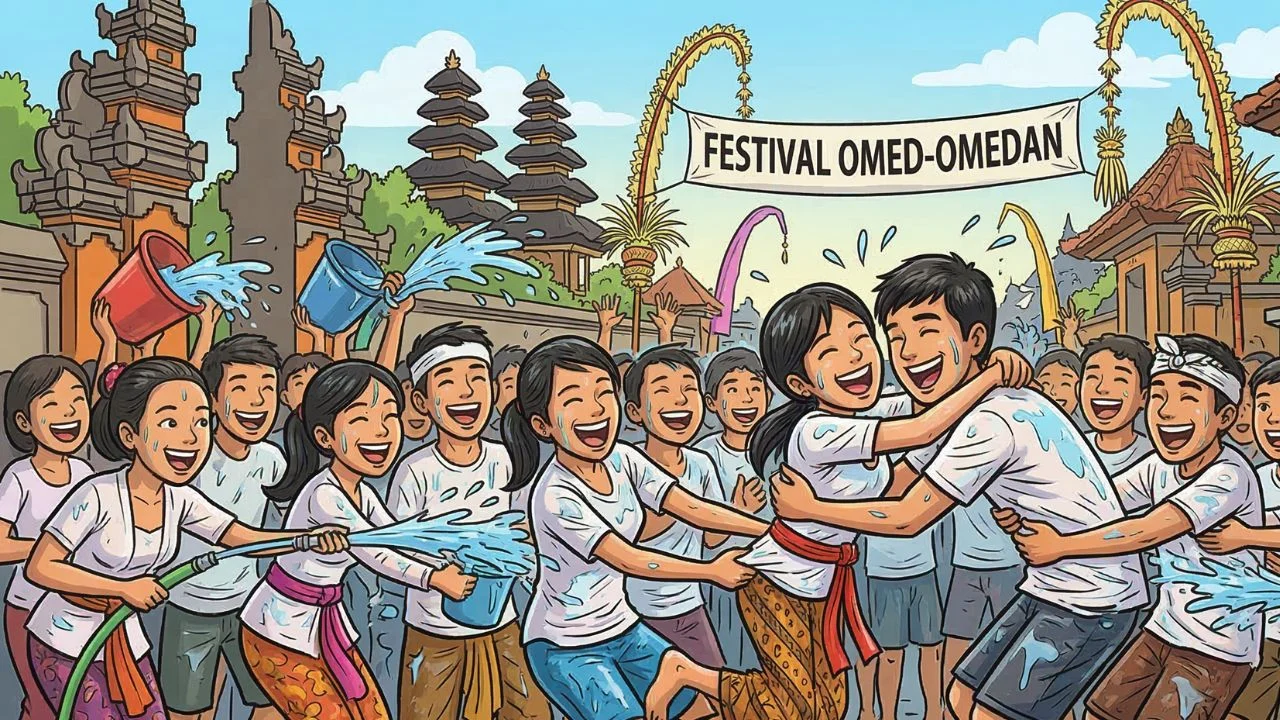
The core of this tradition is a group of youths and a group of maidens facing each other, then one representative from each group is lifted and pushed to the center until they meet. When they meet, they hug, pull each other, and sometimes kiss (usually on the cheek or forehead, though sometimes on the lips due to push enthusiasm). At the peak moment, spectators and organizers douse them with water until they’re soaking wet! Super fun, right?
But once again, this isn’t just an event for profiting from opposite-sex hugs. If you see it live, the atmosphere is full of laughter, family vibes, and spirited shouts. The water poured also has meaning to cool the atmosphere, both physically and emotionally.
History and Myths: Starting from a Sick King
Now, the question is, how did this pull-pull tradition come about? What’s the story?
The handed-down story in Sesetan Village says this tradition has existed since the 17th century, precisely in the kingdom era. Back then, in the Sesetan area, there was a palace (istana) named Puri Oka. One day, the palace elder or king living there fell seriously ill. He had tried various treatments, but nothing worked.
On the same day (exactly on Ngembak Geni celebration), young people around the palace were happily playing pull-pull. They were laughing loudly, shouting, and making a super noisy atmosphere. Hearing the ruckus, the king who had a headache and needed rest naturally felt disturbed. He finally came out of his room intending to get angry and disperse the young crowd.
But what happened was totally unexpected. As soon as he came out and saw the cheerfulness of the young people playing pull-pull, suddenly the pain in his body disappeared! His mysterious illness healed completely right then. The king even felt happy seeing his people harmonious and full of laughter.
Feeling that the game brought healing and positive aura, the king finally ordered the pull-pull game (Omed-omedan) to be held every year on Ngembak Geni day. Since then, this tradition officially became a mandatory annual agenda in Banjar Kaja Sesetan.
The “Two Fighting Pigs” Tragedy and Tolak Bala
There’s another equally mystical story about Omed-omedan. Residents of Banjar Kaja Sesetan don’t dare mess around or try to eliminate this tradition. Why? Because there was a scary incident when the tradition was once skipped.
Once upon a time (allegedly during the Dutch colonial era), authorities banned Omed-omedan because it was deemed disturbing public order. The residents had no choice but to comply and not hold the tradition.
What was the consequence? Suddenly, in the middle of the village, two large wild boars appeared fighting each other (in Bali called babi mepantigan). The fight between the two boars terrified the residents half to death. Not only that, after the boar fight, the village was hit by disasters and mysterious disease outbreaks that struck residents repeatedly.
Village elders finally sought spiritual guidance, and the answer was clear: the calamities came because they dared to stop the Omed-omedan tradition. Since that terrifying incident, no authority or resident has dared to ban this tradition. Even during the recent COVID-19 pandemic, Omed-omedan was still held, albeit with very strict health protocols and only involving a few representatives so the tradition continued without inviting danger.
So, for locals, Omed-omedan is a Tolak Bala ritual (warding off dangers) as well as a form of gratitude to God and ancestors.
How Does the Omed-omedan Process Unfold?
If you get a chance to visit Sesetan during Ngembak Geni, you’ll see the main banjar road already cleared of vehicles. The asphalt is usually already wet in preparation for the event. So, what’s the sequence?
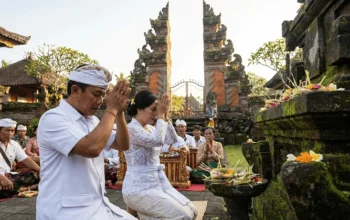
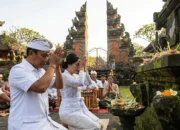
Joint Prayer (Pekeling): The event doesn’t start right away with pushing. The participating youths and maidens first gather at Pura Banjar. They pray together, asking for safety and smooth event from Ida Sang Hyang Widhi Wasa (the One God). Here, they are also sprinkled with holy water (tirta) by the pemangku (priest).
Cultural Showcase (Barong Bungkung): Before the peak event, there’s usually a traditional arts performance first, one of which is the Barong Bungkung dance (pig-shaped barong). This commemorates the past boar fight story.
Forming Lines: After the ceremony, youths (teruna) and maidens (teruni) are divided into two groups facing each other. The distance is quite far, on the north and south sides of the road. The atmosphere heats up with fast, pounding gamelan beleganjur music!
Pull-Pull Action: Organizers (usually elders or pecalang) give the signal. The boys’ group lifts one representative forward (usually carried or lifted together). Same with the girls’ group. Then, both lines run forward while pushing each other until the two representatives meet in the middle…
Peak Moment & Water Dousing: When the two representatives meet, they must hug tightly. That’s when the pull-pull happens (omed-omedan). If they kiss, the crowd cheers louder. In the midst of the hug, organizers with buckets of water douse them heavily! The water dousing signals to separate them. Without it, they sometimes can’t let go due to strong pushes from behind.
After one pair finishes, they retreat, and the next pair is lifted. This continues until the event ends. The road becomes muddy, everyone soaking wet, but smiles and laughter never leave their faces.
Deep Meanings: Not Just Physical
For outsiders seeing only photos or TikTok/Instagram clips, they might judge, “What kind of tradition is that? So impolite!” Hey, don’t misunderstand. Residents of Banjar Kaja Sesetan uphold moral values in this tradition. There are many philosophical meanings embedded:
Menyama Braya (Brotherhood): This is a networking event. After a day of Nyepi (where people are forbidden to go out and chat), Omed-omedan becomes a moment to meet peers, greet each other, and strengthen sibling bonds among banjar residents.
Harmony: The hug in Omed-omedan symbolizes the meeting of positive and negative energies (Purusha and Pradana) that birth harmony for the village.
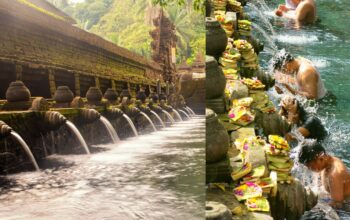
Self-Purification: The water dousing isn’t just for fun or separating hugs. Water symbolizes cleansing and purification. Hopefully, after participating in Omed-omedan, the youths’ minds and souls are clean again, ego and anger melted by the cold water.
“Tinder” Traditional: Matchmaking Event?
Now, this is the most fun fact everyone loves! Since participants are single youths and maidens, aka jomblo in the banjar, Omed-omedan indirectly often becomes a cinlok (on-site romance) spot.
Imagine: you’re lifted by friends, then matched with your crush who’s also lifted from the opposite line. Then in front of hundreds of eyes, you hug and get doused together. How not to baper (feel emotional)?
It’s common knowledge in Sesetan that many husband-wife pairs started from “Omed-omedan incidents.” Initially shy, then after the event they chat, court, date, until finally tying the knot. It can be said this is the most epic local wisdom dating app (like Tinder)!
Omed-omedan Modern Era: Sesetan Heritage Omed-omedan Festival
Over time, the tourism potential of Omed-omedan is increasingly eyed. Smart locals don’t want this tradition to just pass as a ritual. So, it’s packaged as the Sesetan Heritage Omed-omedan Festival (SHOF).
This festival usually runs all day. So, roads around Banjar Kaja Sesetan aren’t just closed for Omed-omedan, but along the road there are UMKM (Micro, Small, Medium Enterprises) bazaars. You can find various Balinese local foods, fresh drinks, to souvenirs. Plus, there’s an entertainment stage featuring local Bali bands, indie musicians, and traditional dances.
So, if you come here, you can shop first, watch live music, then in the afternoon watch the peak Omed-omedan event. This proves a centuries-old tradition can adapt to modern lifestyles without losing its sacredness.
Tips for Those Who Want to Watch Live!
Getting curious and want to add Omed-omedan to your Bali vacation bucket list next year? Absolutely! But note these tips for a safe and comfortable viewing experience:
Arrive Early: Since it’s a once-a-year event, thousands attend—from locals, domestic tourists, to foreigners with big cameras. If you arrive close to event time (usually starts around 2 or 3 PM), you’ll struggle for front spots. Come from noon to book a good viewing spot.
Casual but Modest Clothes: Remember, it starts with a religious procession at the temple. Wear modest clothes. T-shirt and long pants or knee-length shorts are totally fine. Avoid overly revealing outfits.
Prepare to Get Wet!: Even as a spectator, your chance of getting splashed or even doused is huge! Organizers like pranking spectators to amp up the vibe. So, better wear flip-flops, bring change of clothes in your bag, or use a thin raincoat if you really don’t want to get wet.
Secure Electronics: Got an expensive phone or mirrorless camera? Must bring dry bag or waterproof case (waterproof protector). Don’t let your aesthetic Insta-story plan end with your phone dead from a bucket of water from organizers.
Mind Your Behavior: Cheering along is fine, but maintain manners. Don’t litter in the banjar area and follow directions from local pecalang (customary security).
Conclusion
The Omed-omedan tradition in Bali is real proof of how a culture can survive across eras. Starting from a sick king’s story and fighting pigs, this tradition evolved into a much-awaited cultural festival.
Omed-omedan teaches us that preserving tradition doesn’t have to be rigid and boring. Through laughter, pull-pull, warm hugs, and cold water dousing, Banjar Kaja Sesetan society successfully maintains harmony, wards off dangers, while entertaining thousands.
How’s that, cool story right? If you plan to Bali during Nyepi celebration, don’t head home the next day. Stop by Sesetan and feel the extraordinary energy of this tradition yourself!