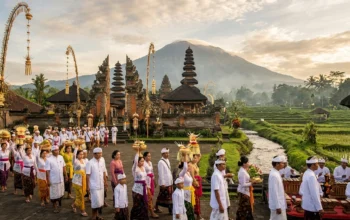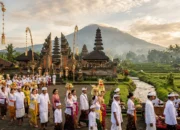


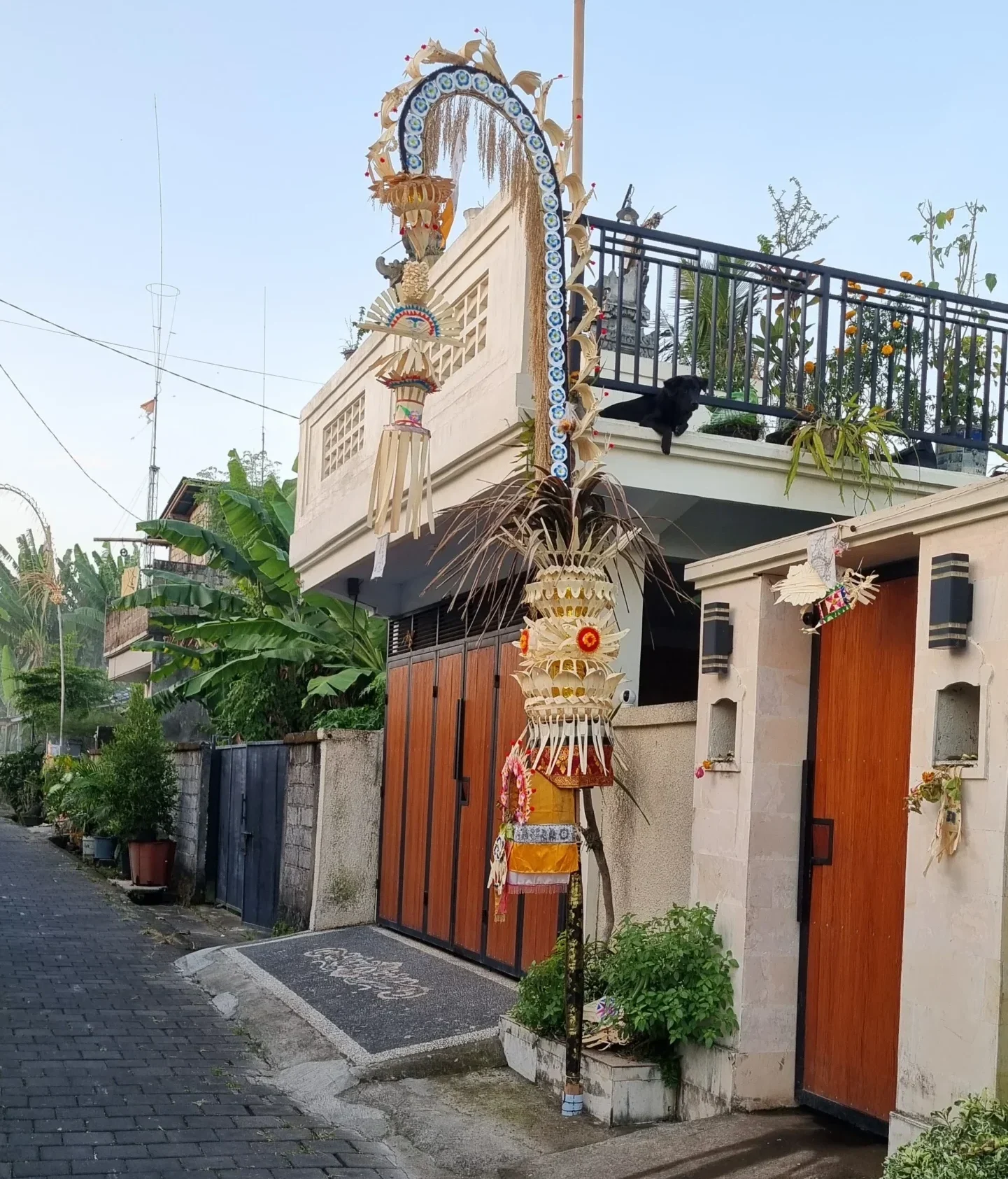
If you’ve ever been to Bali during the Galungan holiday, your eyes must have been spoiled by the sight of rows of curved bamboo decorated beautifully along the streets. Main roads and small alleys turn aesthetic and colorful. Well, this magnificent decoration is called penjor.
But, did you know that penjor is not just a decoration to make the streets look aesthetic for photos? For the Hindu community in Bali, penjor holds a sacred position and is full of deep meaning. Let’s break down together what the meaning, philosophy, and story behind this penjor are in a relaxed language.
Symbol of Mount Agung and Gratitude
Visually, the curved shape of the penjor downwards is very similar to a mountain. In the belief of Balinese Hindus, mountains—especially Mount Agung—are very sacred places. Mountains are considered the abode of the gods and also the source of all life because from there water flows to the rivers that irrigate the rice fields.
So, when the Balinese people make penjor, it is a visual representation of Mount Agung. The bamboo curve at the top depicts the majestic peak of the mountain. Through this penjor, Hindus express immense gratitude to Sang Hyang Widhi Wasa (God Almighty) in His manifestation as the God of Mount Agung, for all the blessings, prosperity, and agricultural products that have been enjoyed so far.
Analyzing the Elements of Penjor: The Symbol of Naga Basuki
If we look more closely, the penjor actually symbolizes the figure of Naga Basuki. In Hindu mythology, Naga Basuki is a symbol of prosperity and welfare.
To avoid confusion, let’s break down the parts of the penjor and their resemblance to the dragon:
Curved bamboo: This is depicted as the back and head of a dragon that is bowing down. This bowing nature also teaches humans to stay grounded and not be arrogant, similar to the philosophy of rice that becomes more humble as it fills.
Janur decoration (Ceper/Sampi): This symbolizes the beautiful scales of the dragon.
White or yellow cloth at the tip of the penjor: Symbolizes the sacred hair or crown of the dragon.
Cloth, Agricultural Products, and Snacks: Why Must They Be There?
Try approaching a random penjor. You will not only see beautifully carved janur, but also various agricultural products hanging there. There are coconuts, bananas, sugarcane, market snacks, and rice. Why do these items have to be hung with such effort?
All the hung items are called pala bungkah (tubers) and pala gantung (fruits). The presence of these agricultural products is not without reason. They are symbols of clothing, food, and shelter provided by nature for humans. By hanging them on the penjor, the Balinese people are saying, “Here, God, the agricultural products You have given, we offer a small portion back as a sign of gratitude.”
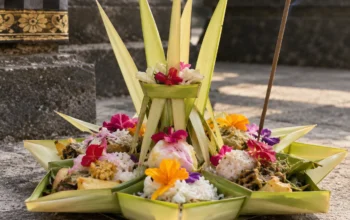
At the bottom of the penjor, there is usually a small bamboo container called Sanggah Ardha Candra. In this place, offerings or banten are placed as the main complement. Without these offerings, the penjor would just be an ordinary bamboo decoration without spiritual value, i.e., a decorative penjor, not a sacred penjor.
Penjor as a Symbol of Dharma’s Victory over Adharma
The Galungan holiday is celebrated as the day of victory of Dharma (goodness) over Adharma (evil). The penjor standing tall and majestic in front of every house gate (angkul-angkul) serves as the flag of that victory.
When the penjor is neatly displayed, it signifies that the residents are ready to welcome the day of victory with a clean heart. The penjor becomes a reminder for everyone passing by that goodness will always win in the end, as long as we are willing to control the ego and desires within ourselves.
Types of Penjor: Between Sacred and Decorative
Now, this is the important point that often causes misunderstandings. It turns out that not all penjor you see in Bali have the same spiritual function. Broadly speaking, the Balinese people divide penjor into two main types based on their purpose: Sacred Penjor (Ceremonial) and Decorative Penjor (Decoration).
Although they look similar at a glance, if observed more closely, there are fundamental differences in terms of completeness, placement, and meaning. Let’s discuss the differences one by one.
1. Sacred Penjor (Ceremonial Penjor)
Sacred penjor is made specifically for religious ceremonies, such as Galungan, Kuningan, and major ceremonies at temples (Piodalan). This type of penjor has the deep philosophical meaning as a symbol of Mount Agung and Naga Basuki that we discussed above.
Due to its sacred nature, the making of sacred penjor must follow certain rules or standards that have been passed down through generations. The main characteristics of sacred penjor include:
Must Have Sanggah: At the bottom of the penjor, a Sanggah Ardha Candra or Sanggah Penjor made of bamboo must be installed. This place functions to place offerings (banten) as a tribute to God.
Must Contain Agricultural Products: This penjor must be hung with pala bungkah (such as yam or cassava) and pala gantung (such as bananas, coconuts, sugarcane), as well as rice and market snacks. This is an absolute requirement as a symbol of gratitude for abundant food.
Equipped with Sacred Items: There is white or yellow cloth at the tip, and it is equipped with paku pidpid leaves, decorated janur, and a lamp or penyenter.
Has Specific Timing: This penjor is only erected on certain days determined by the Balinese calendar and is usually removed after the ceremony ends (e.g., after Kuningan).
2. Decorative Penjor (Penjor Dekorasi/Panyembrama)
As the name suggests, decorative penjor is made purely for aesthetic purposes, beauty, and enlivening the atmosphere. You will often find this type of penjor in front of hotels, restaurants, meeting halls, or along streets where major events take place.
Decorative penjor is usually installed to welcome important guests, cultural festivals, exhibitions, art parties, and even weddings. Because its function is only as decoration, this penjor has no magical or spiritual value.
The characteristics of decorative penjor include:
No Sanggah: Since it is not used for prayer, decorative penjor does not have a place for offerings at the bottom.
Free from Agricultural Products: You won’t find bananas, coconuts, or tubers hanging on this penjor. The main focus is visual beauty, not a symbol of nature’s fertility.
More Flexible and Modern Design: Its creation is not bound by religious standards. So, artists or penjor makers are free to be creative. The janur can be replaced with colorful cloth, styrofoam, decorative paper, or even added with magnificent twinkling lights to look aesthetic at night.
Flexible Installation Time: Decorative penjor can be installed anytime according to the duration of the event, and can even stand for months as long as the bamboo and decorations remain sturdy and look good.
The Making Process: A Space for Mutual Cooperation and Creativity
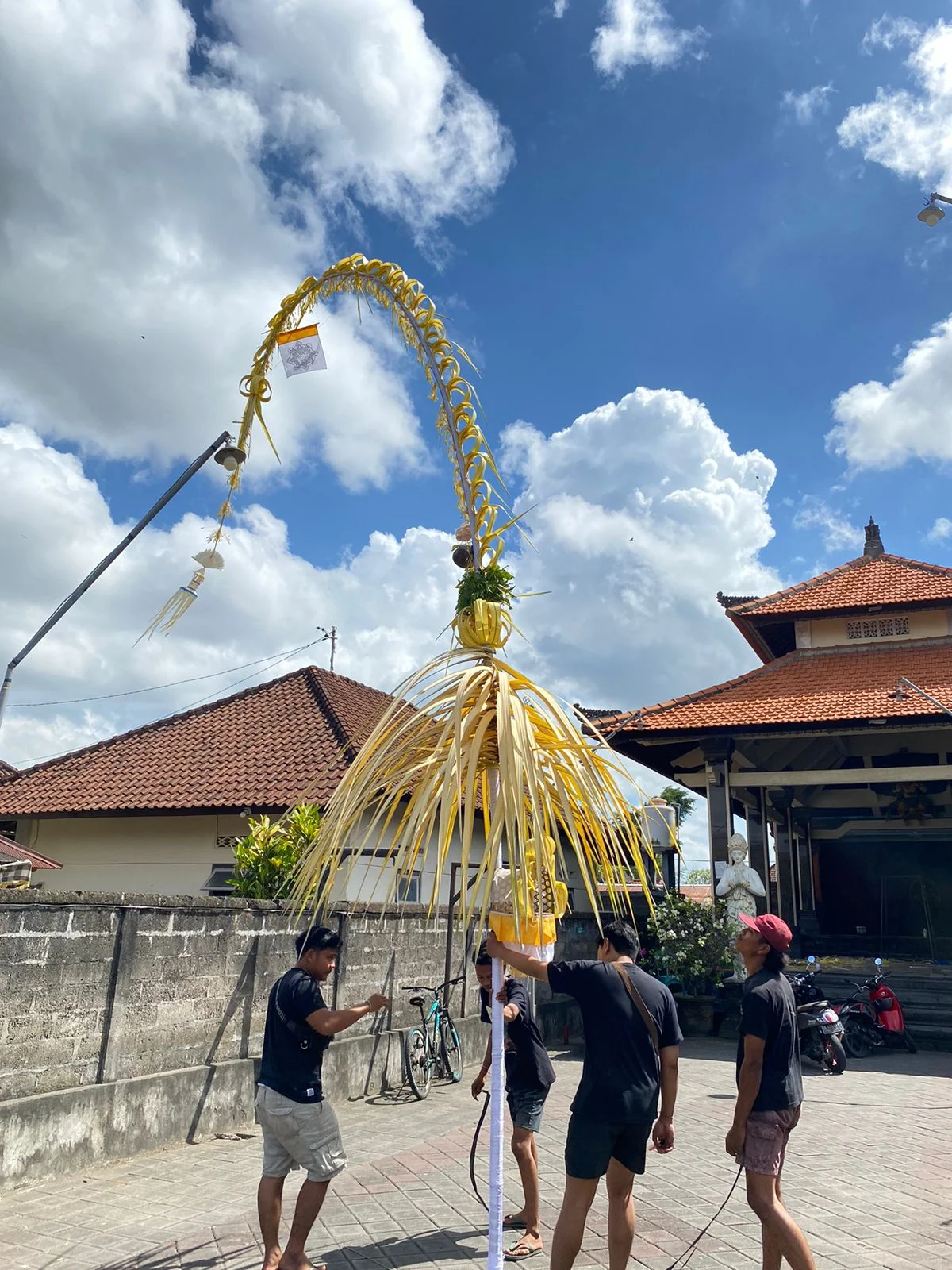
Another thing that makes penjor special is the process of making it. Making a beautiful penjor cannot be instant. Usually, the men in a family or banjar (community) gather one or two days before Galungan, often called Penampahan day.
This is where the social value of penjor becomes apparent. Some are tasked with finding strong straight bamboo, some with arranging janur, some with preparing agricultural products, and the process of erecting it requires extra effort together. This moment becomes an opportunity to chat, joke, and strengthen family and neighborly ties.
Nowadays, many sell instant penjor decorations for practicality. However, the essence of mutual cooperation and sincerity in assembling the bamboo itself remains an irreplaceable part of this tradition.
Conclusion
So, now you know that penjor is not just a curved bamboo that makes the streets in Bali look beautiful when photographed?
Penjor is a masterpiece of art that combines visual beauty with deep spirituality. Inside it, there is a symbol of the sacred mountain, a dragon figure bringing prosperity, an expression of gratitude for agricultural products, and a flag of the victory of good over evil. Through penjor, we are taught to always be grateful to nature and God, while also reminded to remain humble in living life.