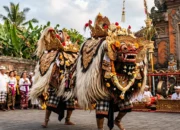


Hello everyone! When we talk about the Island of the Gods, Bali, it feels incomplete to only discuss beautiful beaches or cool hangout spots. Bali is incredibly rich in culture and religious traditions that never cease to amaze us. One of the most anticipated celebrations with a very distinctive atmosphere in Bali is Saraswati Day. For those of you who have lived or studied in Bali, you must be familiar with this holiday. Now, for those who don’t know or want to learn more about the tradition of celebrating the descent of knowledge, let’s discuss it thoroughly in this article.
What Exactly is Saraswati Day?
If we interpret it simply, Saraswati Day is when Hindus in Bali worship Ida Sang Hyang Widhi Wasa (the Supreme God) in His manifestation as Dewi Saraswati. Dewi Saraswati is believed to be the goddess of knowledge, arts, and wisdom. Just look at the statues or paintings of Dewi Saraswati in temples or schools. She is always depicted as a beautiful goddess, with four arms, sitting on a lotus flower accompanied by a swan and a peacock.
Every symbol in the depiction of Dewi Saraswati has a cool meaning. Her beautiful figure symbolizes that knowledge is essentially something beautiful and very interesting to learn. Then, her four hands hold several important objects. There is a keropak or lontar (palm-leaf manuscript) which symbolizes the source of knowledge. There is also a genitri or rosary which symbolizes that the learning process is endless and continues to revolve throughout life. She also holds a veena or rebab musical instrument which symbolizes art, culture, and the harmony of the universe. Meanwhile, the lotus flower symbolizes purity, because the lotus can bloom beautifully even though it lives in muddy places.
When is Saraswati Celebrated?
Unlike other major holidays like Nyepi which is celebrated once a year based on the Saka calendar, Saraswati Day comes more frequently. This commemoration is celebrated every 210 days based on the Balinese Pawukon calendar system. Specifically, this holiday always falls on Saturday Umanis of the wuku Watugunung.
Because it is calculated using the Balinese calendar, which has a shorter cycle than the Gregorian calendar, in one Gregorian year we can sometimes celebrate Saraswati Day up to twice. This commemoration is always identified with school children’s day, because the main focus is giving thanks for the knowledge we gain from education.
The Exciting Atmosphere at Schools on the Day
The peak of the Saraswati Day celebration always occurs on Saturday morning. If you take a walk in Bali on this day, the streets will be filled with school children, from kindergarten to university students, looking very neat and handsome/beautiful. They all wear traditional Balinese attire to school or their respective campuses. The boys usually wear udeng (headcloth), white shirt, and kamen (sarong). Meanwhile, the girls look elegant in kebaya, selendang (sash), and neatly tied hair.
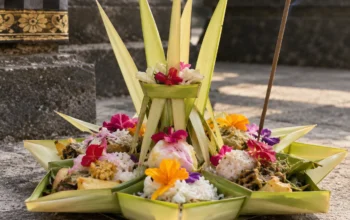
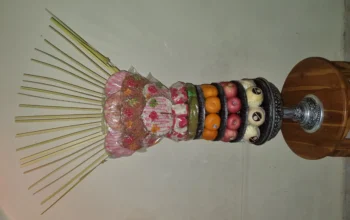
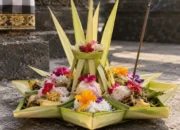
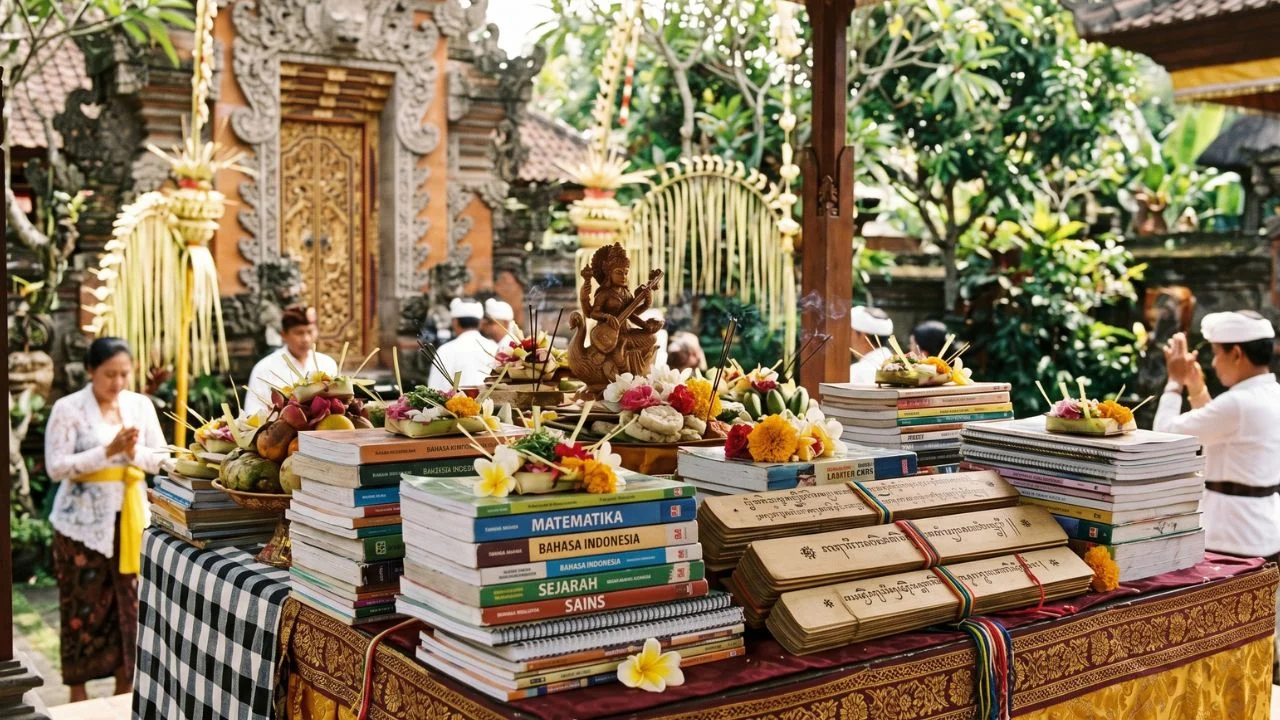
At school, teaching and learning activities are suspended. Instead, all students and teachers gather at the school temple to pray together. Textbooks, notebooks, stationery, and even laptops used for studying are usually collected in one place to be given special offerings (banten). This is a form of gratitude because these objects have become our main media for pursuing knowledge. These books are then sprinkled with tirta or holy water as a symbol of purification.
Unique Taboos During Saraswati
There is one unique thing that is a tradition and belief during Saraswati Day. On this holiday, Hindus have a taboo against reading and writing. Why is that, considering this is a holiday that celebrates the descent of knowledge?
As it turns out, this taboo actually has a very deep symbolic meaning for ourselves. Not reading and writing on Saraswati Day aims to allow us to truly focus on worshipping the goddess and reflecting on the essence of the knowledge we have learned so far. So, instead of continuously adding to memorization or chasing academic grades, that day we are invited to be still and pause for a moment. We are asked to reflect: has the knowledge we possess made us better people, wiser, and more beneficial to others or not? Then, in the evening, we are encouraged to read scriptures or religious books, a tradition called Malam Sastra (Literary Night).
The Banyupinaruh Tradition as the Conclusion of the Series
The series of Saraswati Day apparently does not stop on Saturday. The next day, which is Sunday Paing of the wuku Sinta, Hindus in Bali celebrate a tradition called Banyupinaruh. The word “Banyu” means water and “Pinaruh” comes from the word weruh which means knowledge.
From early dawn, even before the sun rises, the beaches and holy springs in Bali will be filled with a sea of people. They come in droves with family or friends to perform a ritual of holy bathing or melukat. The purpose of the Banyupinaruh tradition is to cleanse oneself or purify the body physically and spiritually after receiving the gift of knowledge on Saraswati Day. Bathing at the beach while enjoying the sunrise with loved ones provides incredible positive energy to welcome the next day. After bathing clean, the activities usually continue with praying and eating together to enjoy typical Balinese dishes.
The Important Meaning of Saraswati for Our Daily Lives
If we think about it further, the meaning of Saraswati Day is very relevant to our lives in the current era. In this fast-paced digital era, information and knowledge can be obtained very easily just by touching our phone screens. However, having a lot of knowledge alone turns out not to be enough to survive well.
Saraswati always reminds us that intellectual intelligence must be balanced with wisdom and good ethics. Knowledge is like a double-edged sword. If held by a good and wise person, knowledge can be used to create technology that greatly helps many people. But if held by someone with wrong intentions, that knowledge can actually damage nature and harm fellow humans. Through this annual celebration, we are always reminded to remain humble and to keep the spirit of lifelong learning, because knowledge is truly vast and boundless. May we all always be given a bright path, clear minds, and beneficial knowledge!