

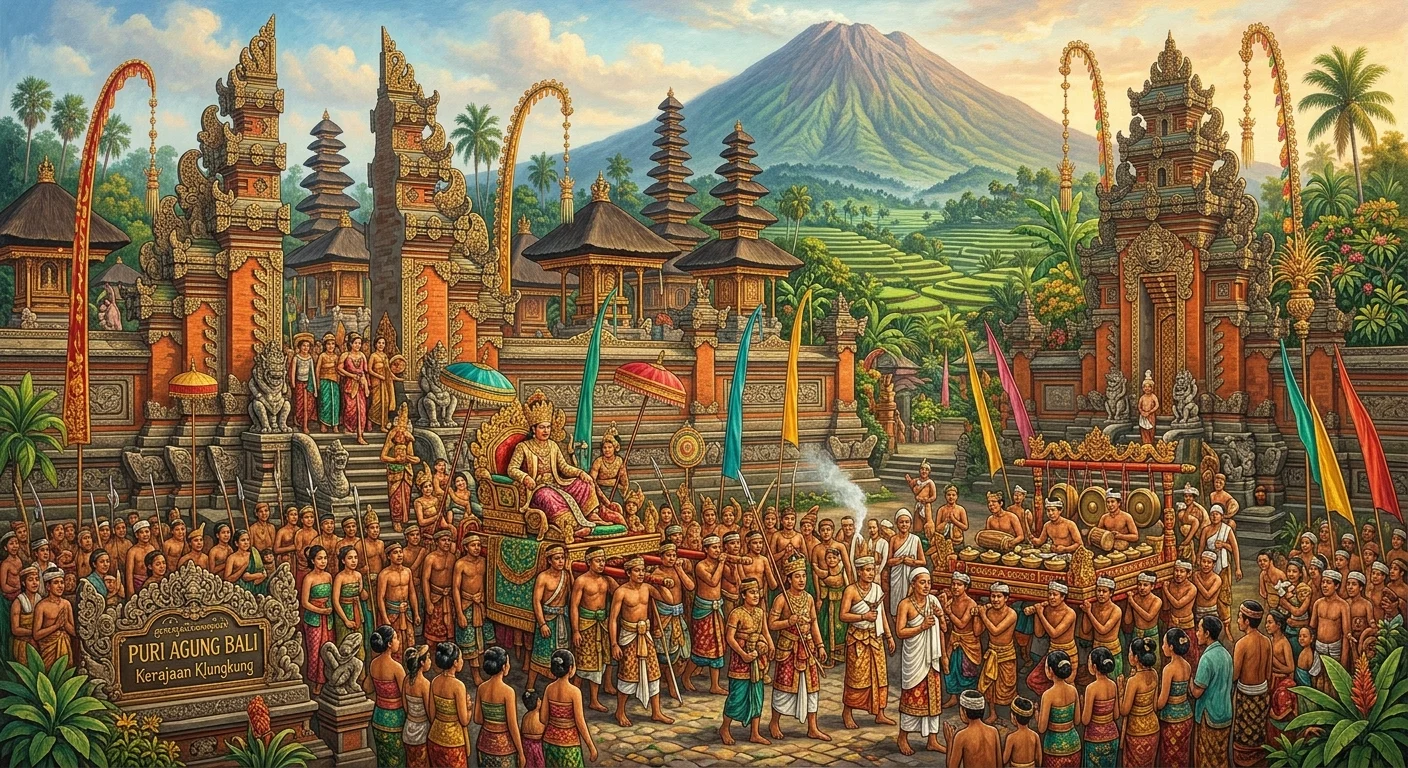
Bali is not only famous for its beaches, temples, and culture. Behind all that, the island of Bali has a fairly long history of kingdoms. Even long before becoming one of the world’s famous tourist destinations, Bali already had a system of government, social life, religion, and culture that developed.
The history of kingdoms in Bali also does not stand alone. Bali’s journey was heavily influenced by kingdoms from Java, especially during the Majapahit era. After that, a number of local kingdoms emerged which then shaped the political and cultural development of Bali up to the Dutch colonial period.
The following is the chronological history of kingdoms in Bali.
The Beginnings of Kingdoms in Bali
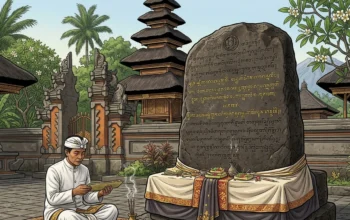
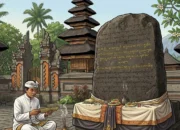
Traces of kingdoms in Bali can be found from around the 9th to the 10th century AD. Information about this period is largely known through ancient inscriptions found in various regions of Bali.
At that time, Bali already had a fairly organized royal government. One dynasty often associated with Bali’s early period is the Warmadewa Dynasty.
The name Warmadewa appears in a number of Ancient Balinese inscriptions. One of the famous kings from this period is Sri Kesari Warmadewa, who is estimated to have ruled around the 10th century.
The existence of the Warmadewa Dynasty shows that Balinese society at that time already knew a royal system, government rules, village management, and religious life.
The Era of King Udayana and Gunapriyadharmapatni
One important period in Balinese history occurred during the reign of King Udayana Warmadewa.
King Udayana ruled together with his wife, Gunapriyadharmapatni, also known as Mahendradatta. She came from the royal family in East Java.
Their marriage strengthened the relationship between Bali and Java.
From this couple were born several sons, one of whom was Airlangga. Airlangga later became one of the famous kings in Java and founded a kingdom centered in East Java.
During Udayana’s time, cultural, religious, and political relations between Bali and Java grew stronger. Hindu influence also increasingly developed in the life of Balinese society.
The Reign of Anak Wungsu
After Udayana’s era, Bali was then ruled by several successors of the Warmadewa Dynasty. One who is quite famous is Anak Wungsu.
He ruled Bali around the 11th century.
During his reign, the life of Balinese society developed quite rapidly. Many inscriptions from the Anak Wungsu period have been found in Bali.
These inscriptions provide a picture of village life, the tax system, religious activities, agriculture, and the relationship between the kingdom and the people.
This shows that Bali’s government at that time already had a fairly orderly administrative system.
Bali on the Eve of Majapahit’s Arrival
After the Warmadewa Dynasty period, power in Bali underwent several changes.
One fairly famous figure from the period before Majapahit’s entry is Sri Astasura Ratna Bumi Banten.
In a number of historical sources, he is often referred to as one of the rulers of Bali before the Majapahit expedition to the island.
At that time, Majapahit, centered in East Java, was in a period of expanding its power.
The kingdom developed into one of the largest powers in the archipelago.
Majapahit Takes Control of Bali
Around the 14th century, Majapahit began to expand its influence to Bali.
During the reign of Hayam Wuruk and Prime Minister Gajah Mada, Majapahit troops carried out an expedition to Bali.
Around the year 1343, Bali successfully came under Majapahit’s influence.
This event became one of the important points in Balinese history because it brought major changes in the political system, social life, culture, and religion.
A number of nobles, priests, artists, and people from Java then came or had increasingly strong influence in Bali.
Elements of Majapahit culture then blended with the local culture that already existed.
This blend became one of the foundations for the development of Balinese culture that can still be felt today.
The Emergence of the Gelgel Kingdom
After Majapahit’s influence grew stronger, the center of power in Bali then developed in the Gelgel area, which is now in Klungkung Regency.
The Gelgel Kingdom became one of the most influential kingdoms in Balinese history.
Gelgel’s golden age is often associated with the reign of Dalem Waturenggong around the 16th century.
During this period, the influence of the Gelgel Kingdom was quite extensive.
Besides controlling most of Bali, its influence is also said to have reached several areas outside Bali, including Lombok and parts of the region around Nusa Tenggara.
The reign of Dalem Waturenggong is also known as an important period in the development of Balinese art, literature, religion, and culture.
The Role of Dang Hyang Nirartha
Around the time of the Gelgel Kingdom, Bali also experienced major development in religious life.
One very well-known figure is Dang Hyang Nirartha, a Hindu priest who came from Java.
He had an important influence on the development of Hindu teachings in Bali.
The name Dang Hyang Nirartha is also often associated with a number of famous temples in Bali, including Tanah Lot Temple, Uluwatu Temple, and several other sacred places.
His presence had a major influence on the development of the religious and spiritual traditions of Balinese society.
The Gelgel Kingdom Begins to Weaken
After experiencing its golden age, the power of the Gelgel Kingdom slowly began to weaken.
Political rivalry and internal conflict caused the center of government to eventually move from Gelgel to Klungkung.
From here then emerged the Klungkung Kingdom, which became one of the important political centers in Bali.
However, unlike the Gelgel period, Bali’s power at that time was already increasingly divided.
A number of regions began to develop into their own kingdoms.
The Emergence of Many Kingdoms in Bali
Around the 17th to 19th centuries, Bali was no longer entirely under one large kingdom.
Instead, several kingdoms emerged that had their own territories and governments.
Several famous kingdoms in Bali at that time included:
- Klungkung Kingdom
- Badung Kingdom
- Mengwi Kingdom
- Gianyar Kingdom
- Karangasem Kingdom
- Bangli Kingdom
- Tabanan Kingdom
- Buleleng Kingdom
Relations between kingdoms were not always peaceful.
Sometimes cooperation occurred, but at other times rivalry and conflict also emerged to expand territory or political influence.
Nevertheless, these kingdoms also played a major role in the development of Balinese culture.
Many temples, palaces, traditions, dance arts, gamelan, and literary works developed through the support of royal families.
The Karangasem Kingdom and Its Influence in Lombok
One Balinese kingdom that had considerable influence was the Karangasem Kingdom.
This kingdom was located in the eastern part of Bali.
During its development, Karangasem succeeded in expanding its influence to the island of Lombok.
Balinese influence in Lombok then left various cultural traces that can still be found today, especially in the Balinese communities living there.
The relationship between Bali and Lombok during the kingdom period is also an important part of the political history of the region.
The Arrival of the Dutch in Bali
Entering the 19th century, the Dutch colonial government became increasingly active in expanding its power in the archipelago, including to Bali.
However, the process of controlling Bali did not happen all at once.
The Dutch had to face resistance from various Balinese kingdoms.
One major conflict occurred in the northern Bali region, especially against the Buleleng Kingdom.
The Dutch carried out several military expeditions to Bali before finally succeeding in expanding their control.
Puputan Badung 1906
One of the most famous events in Balinese history is the Puputan Badung in 1906.
Puputan can be understood as a form of resistance to the very end.
When Dutch troops entered the Badung region, the royal family together with their followers chose to face the colonial troops directly.
This event claimed many victims and became one of the symbols of Balinese resistance against colonialism.
Today, the Puputan Badung event is remembered, among other ways, through Puputan Badung Square in Denpasar.
Puputan Klungkung 1908
Two years after Puputan Badung, another major event occurred in Klungkung.
In 1908, Dutch troops faced the Klungkung Kingdom.
The event is known as the Puputan Klungkung.
After this event, the political power of Balinese kingdoms increasingly came under the control of the Dutch colonial government.
Although the royal system no longer had political power as before, puri families still had an important role in the social and cultural life of Balinese society.
Balinese Kingdom Heritage That Can Still Be Seen
Although the kingdom era has long passed, its legacy is still easy to find when visiting Bali.
One of the most obvious is the existence of puri, the residential complexes of royal families.
Some puri are even still used by descendants of royal families today.
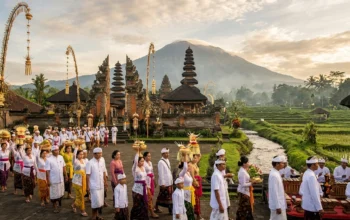
Besides puri, kingdom heritage can also be found through temples, dance arts, gamelan, traditional ceremonies, community organization systems, and traditional literary works.
Several places such as Kerta Gosa in Klungkung, Puri Agung Karangasem, and various puri in Ubud, Gianyar, Mengwi, and other areas serve as reminders that Bali has a long history of political and cultural journey.
Conclusion
The history of kingdoms in Bali lasted for hundreds of years and went through many changes.
Its journey began with the Ancient Bali kingdom and the Warmadewa Dynasty, then continued with increasingly strong relations between Bali and Java.
The entry of Majapahit influence in the 14th century then became an important point that shaped many elements of Balinese culture.
After that emerged the Gelgel Kingdom, which reached its golden age during the time of Dalem Waturenggong. When Gelgel’s power weakened, Bali then split into a number of kingdoms such as Klungkung, Badung, Mengwi, Gianyar, Karangasem, Bangli, Tabanan, and Buleleng.
Entering the 19th century and the early 20th century, these kingdoms had to face the expansion of Dutch power. The Puputan Badung event in 1906 and Puputan Klungkung in 1908 became an important part of the end of the era of traditional Balinese kingdom political power.
However, the heritage of Balinese kingdoms has not truly disappeared.
Puri, temples, traditions, arts, and various customs that developed since the kingdom era are still an important part of Balinese society’s life today.