

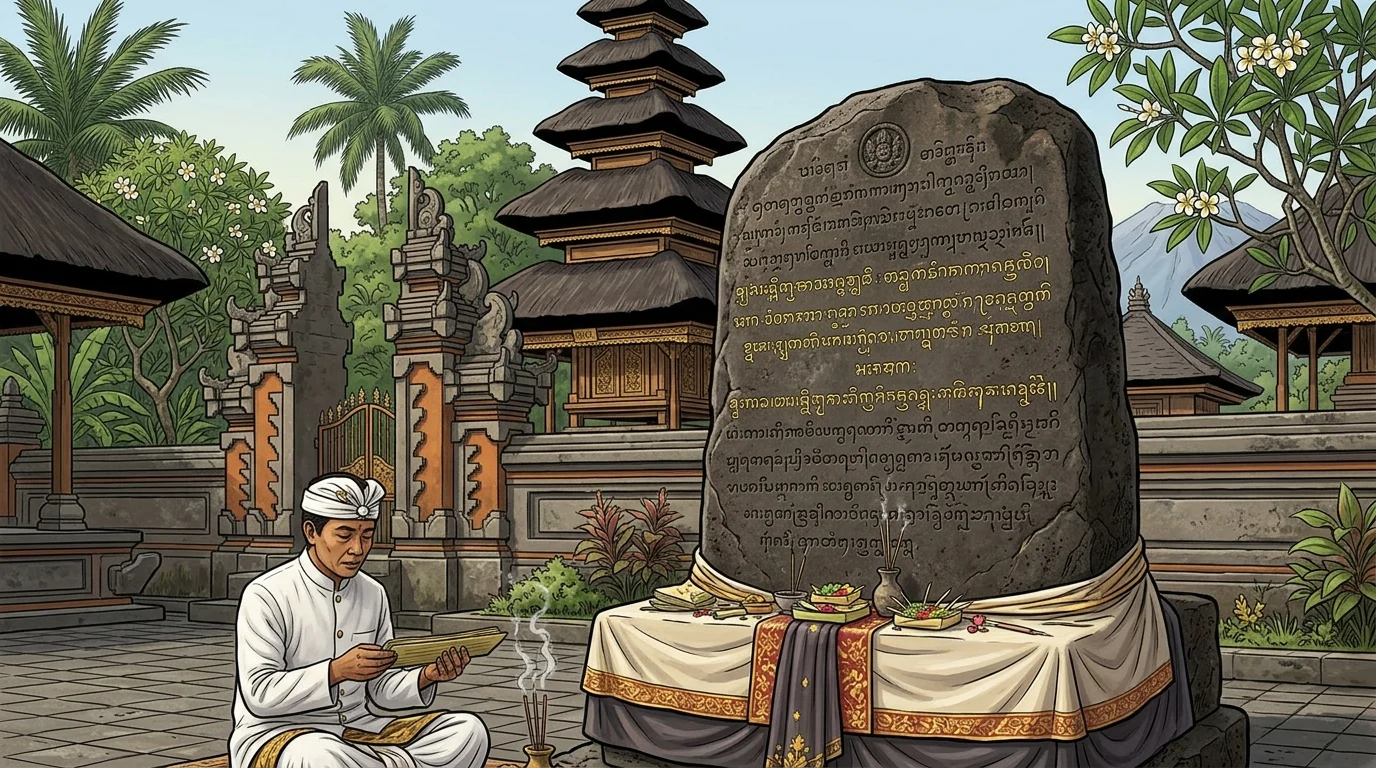
Bali is known for its temples, traditions, art, and culture that are still alive today. However, long before modern historical records were made, Balinese society had already left various written evidence in the form of inscriptions.
Inscriptions are an important source for understanding the life of Balinese society in the past. From these objects, we can learn the names of kings, the system of government, religious life, trade, agriculture, and the rules that applied in a village.
Inscriptions themselves are usually written or carved on durable materials such as stone and metal. In the tradition of Hindu-Buddhist kingdoms, inscriptions often served as official documents issued by kings or royal officials.
Interestingly, the inscriptions found in Bali are quite numerous and come from different periods. Here are some important inscriptions that have been found in Bali, arranged based on the estimated time or year of their creation.
1. Stupika Inscriptions and Pejeng Inscription Fragments
Before the appearance of Balinese inscriptions with clear year numbers, there were actually several older written remains.
A number of inscriptions were found on clay stupikas containing Buddhist mantras. This kind of writing tradition is estimated to have been known in Bali around the 8th century AD.
In addition, in the Pejeng area, several inscription fragments in Sanskrit with Old Balinese script were also found. Based on the shape of the letters, some of these fragments are estimated to date from the early 9th century AD.
The content that can still be read includes matters related to Hindu Shiva teachings. However, because these inscriptions do not have year numbers, their age is known through comparison of letter forms with other inscriptions from the same period.
These findings show that writing culture in Bali had actually developed before the emergence of the Old Balinese kingdom whose historical records are clearer.
2. Sukawana A I Inscription – 882 AD
The Sukawana A I inscription is one of the most important inscriptions in Balinese history because it is the oldest inscription in Bali with a clear year number.
This inscription is dated 804 Saka or 882 AD.
The Sukawana inscription is related to the Kintamani area. Its contents include discussion of the construction of a hermitage and lodging place for monks. It also mentions several names of religious leaders such as Siwakangsita, Siwanirmala, and Siwaprajna.
Interestingly, this inscription does not mention the name of a king. Instead, there is the name Singhamandawa, which is thought to be related to the center of government at that time.
The Sukawana inscription also provides a picture of artistic life. Several terms related to musicians, drums, gamelan, and wind instruments already appear in this inscription.
This means that the artistic activities now so closely associated with Bali actually have very long historical roots.
3. Bebetin A I Inscription – 896 AD
Next is the Bebetin A I Inscription dated 818 Saka or 896 AD.
Like Sukawana, this inscription also comes from the Singhamandawa period and does not yet include the name of a king.
One interesting part of the Bebetin Inscription is the mention of various artistic activities. There are terms referring to gamelan players, singers, angklung players, drum players, flute players, mask performances, and wayang puppeteers. In other words, by the end of the 9th century, Balinese society already knew forms of performance, some of which can still be found today.
Inscriptions from this period also help us understand that the life of Balinese society at that time was not only related to kingdom and religion, but also to agriculture, work, taxes, and daily social activities.
4. Trunyan A I and Trunyan B Inscriptions – 911 AD
Around the year 833 Saka or 911 AD, the Trunyan A I and Trunyan B inscriptions appeared.
Both belong to the group of early Old Balinese inscriptions from the Singhamandawa period. Just like Sukawana and Bebetin, these inscriptions do not directly mention the name of a king.
The Trunyan inscriptions are important because they provide a picture of the society living around Lake Batur at that time.
The Kintamani highland area was indeed very important in early Balinese history. Many ancient inscriptions have been found in this area and its surroundings.
This is one reason for the emergence of the assumption that the center of Singhamandawa government was around Kintamani.
5. Blanjong Inscription – 913 AD
When discussing famous inscriptions in Bali, the name Blanjong Inscription almost always appears.
This inscription is located in the Blanjong area, Sanur, South Denpasar. Its form is quite different from many other Balinese inscriptions because it is a stone pillar.
The Blanjong Inscription is dated 835 Saka or 913 AD and mentions the name Sri Kesari Warmadewa. He became one of the early rulers whose name is clearly recorded in Old Balinese history.
What makes this inscription even more interesting is its use of two languages and two types of script. In certain parts, Sanskrit is used, while other parts use a language that developed in the Old Balinese-Javanese area. The script also uses different writing systems, including Pranagari and Old Javanese script.
In this inscription, the term Walidwipa is also found, which is related to the mention of the island of Bali.
Sri Kesari Warmadewa did not only leave an inscription at Blanjong. Several other inscriptions associated with him have also been found in areas such as Pukuh, Malet Gede, and Panempahan.
6. Gobleg Pura Desa I Inscription – 914 AD
Not long after the period of the Blanjong Inscription, there is the Gobleg Pura Desa I Inscription dated around 836 Saka or 914 AD.
This inscription belongs to the group of inscriptions related to the Singhamandawa period.
The discovery of inscriptions in the Gobleg area and North Bali shows that the activities of Old Balinese society were not only centered in South Bali or Kintamani.
Traces of kingdoms, settlements, agriculture, and religious activities were already spread quite widely across various parts of the island of Bali.
7. Sembiran A I Inscription – 922 AD
Entering the year 922 AD, we find an interesting record from the Sembiran A I Inscription.
This inscription is important because it provides a picture of trade life and the coastal area of North Bali.
In the inscription, there is information about market officials in Julah. Archaeological sources also link the Sembiran and Julah areas with port and trade activities during the Old Balinese period.
This is interesting because Old Balinese life is often imagined as centered only on agriculture and the royal area in the interior.
In fact, North Bali also had fairly active maritime relations. Ships, markets, trade, and rules concerning goods found from shipwrecks also appear in the historical records of the region.
8. Serai A II Inscription – 993 AD
At the end of the 10th century, Bali entered the reign of Gunapriyadharmapatni and Dharma Udayana Warmadewa.
One of their legacies is the Serai A II Inscription, dated 915 Saka or 993 AD.
The reign of this royal couple is important because the structure of Balinese government became clearer.
The Serai A II Inscription, among other things, mentions groups of Shiva and Buddha religious leaders within the government environment. From this, it can be known that religious life during the Old Balinese period was quite complex and involved various religious groups.
9. Batuan Inscription – 1022 AD
Next is the Batuan Inscription dated 944 Saka or 1022 AD.
This inscription is related to the reign of King Marakata. Until now, several plates of the inscription are kept in the Pura Puseh area of Batuan Village, Gianyar.
The Batuan Inscription provides information about society, religious activities, education, art, and the obligations of the population.
It also contains records about the Pakerisan area, one of the areas that later developed into an important region in Balinese religious history.
The name Air Gajah is also found in the Batuan Inscription. Researchers then tried to connect it with the area around the Petanu River and the Goa Gajah site, although this connection still requires further research.
10. Tengkulak A Inscription – 1023 AD
Only about one year after the Batuan Inscription, the Tengkulak A Inscription appeared in 945 Saka or 1023 AD.
One of the most interesting pieces of information in this inscription is the mention of a hermitage named Amarawati in the Pakerisan River area.
This location is then widely associated with the Candi Tebing Gunung Kawi area in Tampaksiring.
Gunung Kawi itself has a number of ancient writings, one of which reads haji lumah ing jalu. This inscription is related to the worship place of the Balinese royal family during the period of Udayana, Marakata, and Anak Wungsu.
11. Pandak Bandung Inscription – 1071 AD
The next inscription is interesting because it is related to one of the agricultural systems that until now has become an identity of Bali: subak.
In the Pandak Bandung Inscription of 1071 AD, the term kasuwakan is found. This term is considered related to the early form of the word kasubakan or subak.
This is one piece of evidence that the regulation of agriculture and water distribution in Bali has had an organization since hundreds of years ago.
A year later, in an inscription from the reign of King Anak Wungsu in 1072 AD, the term kasuwakan rawas is also found.
So, Bali’s traditional irrigation system is not something that only developed in recent centuries, but has very old historical roots.
12. Pura Kehen Inscriptions
Pura Kehen in Bangli also preserves several inscriptions from different periods.
The oldest inscription is estimated to date from around 882–914 AD. Another inscription dates from around 1016–1049 AD, while the third inscription is dated 1204 AD.
Its long time span is interesting because it shows that this area was used and considered important for several generations.
The name that appears in the early inscriptions is related to Hyang Api, which later developed into Hyang Kehen and finally became known as Pura Kehen.
What Can We Learn from Balinese Inscriptions?
Inscriptions are not merely stones or metal sheets inscribed with ancient letters. From inscriptions, we can see how Balinese society developed over hundreds of years.
The Sukawana Inscription gives a picture of religious and governmental life at the end of the 9th century. Bebetin and Trunyan show the social and artistic life of the community. Blanjong introduces the name Sri Kesari Warmadewa. Sembiran opens the story of trade and ports in North Bali. Meanwhile, Batuan, Tengkulak, and Pandak Bandung show the development of religion, agriculture, and irrigation systems.
The inscription records found in Bali also show the existence of many rulers during the Old Balinese period. Based on studies of the inscriptions that have been found, at least around 21 different rulers are recorded over a span of several centuries.
Therefore, the list above is actually only part of the many inscriptions that have been found in Bali.
Conclusion
Inscriptions are one of the most important sources for understanding Balinese history before modern records existed. Through inscriptions, we can see that Balinese society in the past already had a system of government, religious life, art, trade, agriculture, and fairly organized social rules.
Starting from the Sukawana Inscription of 882 AD, Bebetin, Trunyan, Blanjong, Sembiran, Batuan, Tengkulak, to various inscriptions from the time of Anak Wungsu and later periods, all form pieces of a long story about the development of the island of Bali.
Interestingly, many things mentioned in these inscriptions still feel close to Bali today. Gamelan, agriculture, irrigation systems, temples, and village community life have traces that apparently already appeared in written sources more than a thousand years ago.