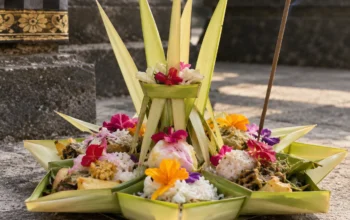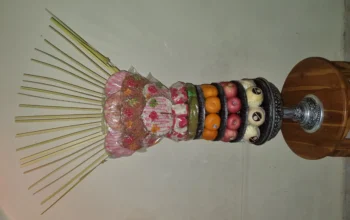


For Balinese people, there is one small ritual that is almost certainly performed every day, right after cooking in the morning. The ritual is called Mebanten Saiban (also often called Ngejot or Yajna Sesa).
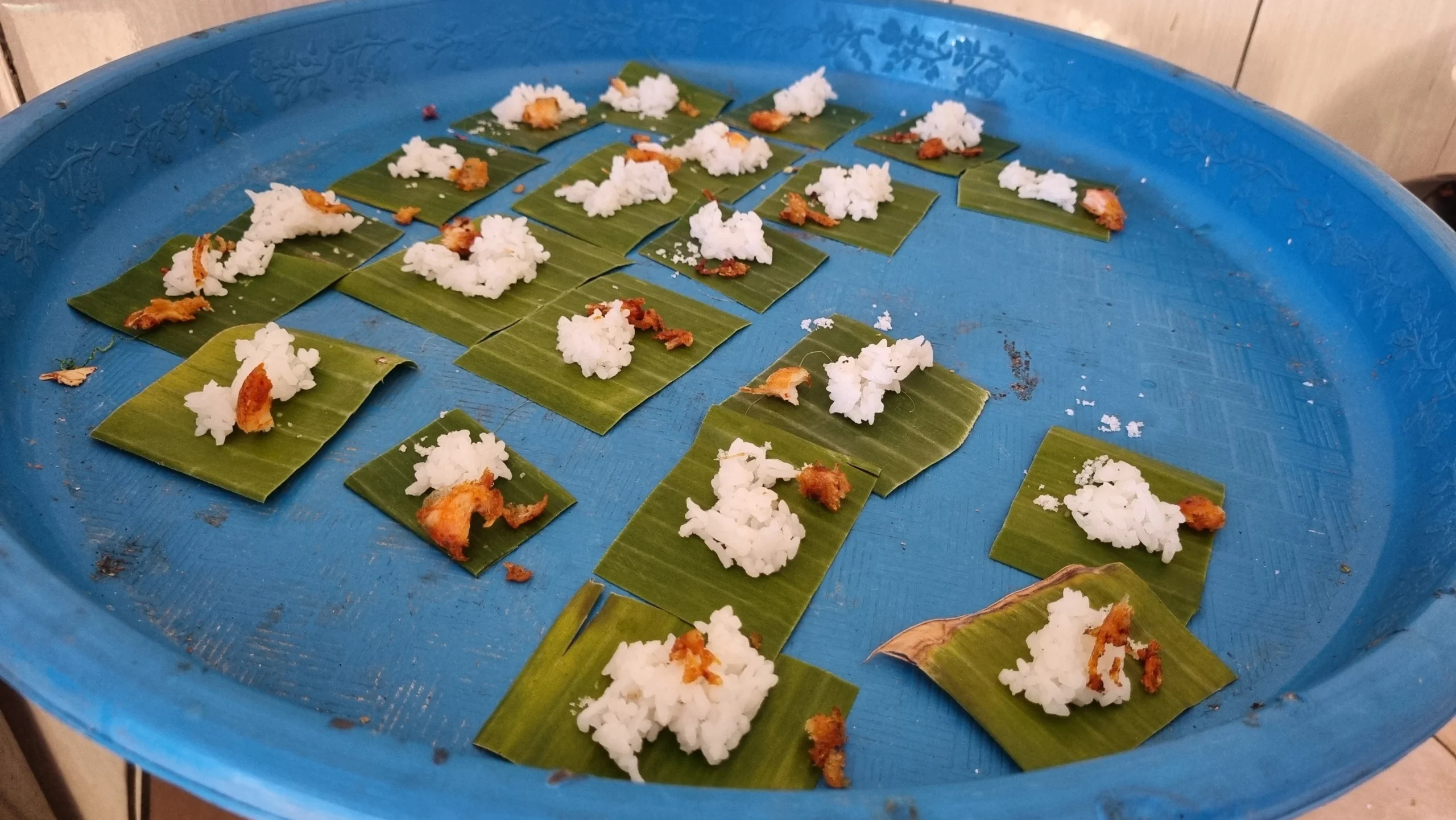
If you go to Bali and walk in front of local residents’ houses around 7 to 9 in the morning, you will often see small containers made of banana leaves containing a little rice and side dishes placed on the floor, on the stove, or near a water source.
So, what is the actual meaning behind this simple habit? Let’s discuss it in a casual way!
What is Mebanten Saiban?
Literally, Saiban means “newly cooked food” or the first cooked food that has not been touched (not yet eaten by anyone).
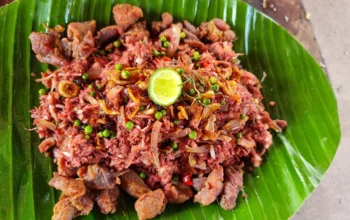
So before the household eats breakfast, a little bit of the newly cooked food is “set aside” as an offering. The container is very simple, usually just a small square piece of banana leaf (tamas small or ituk-ituk). The contents are whatever is cooked that day—if you cook rice, water spinach, and fried tofu, that is what is offered.
Deep Meaning Behind the Simple Ritual
Although it seems trivial and only takes 5 minutes, Mebanten Saiban has very deep spiritual and social meaning for Hindus in Bali:
1. The Smallest but Most Real Gratitude
This is a form of direct thanks to Ida Sang Hyang Widhi Wasa (God) in His manifestation as Dewi Sri (Goddess of Fertility/Rice) and Dewa Brahma (God of Fire/Kitchen) because the family can still eat that day. Balinese people believe that what we eat today is a blessing, so it is only right that God “tastes” it first through this offering.
2. Paying “Debts” to Nature (Panca Yadnya)
Consciously or not, when we cook, we do small “destruction” to nature. We cut vegetables, pick chilies, light a fire, use water, and maybe even accidentally kill ants or small insects while cleaning the kitchen.
Mebanten Saiban is a ritual to atone for these small sins (Bhuta Yadnya). We thank and apologize to the natural elements (earth, water, fire, air) that have sacrificed themselves for our survival.
3. Sharing with Invisible Beings
In the Balinese Hindu concept, the universe is inhabited by sekala (visible) and niskala (invisible) beings. The saiban offering placed on the floor or in the yard is intended for the Bhuta Kala (forces of the underworld or spirits around the house).
The purpose is noble: sharing food. The logic is, if the beings around the house are already “full” and greeted well, they will not disturb the harmony of our household. This is a tangible form of the concept of Tri Hita Karana (maintaining good relations between humans and nature/environment).
Where is This Offering Placed?
Usually, the saiban offering is placed in vital places related to daily activities at home, for example:
Pelinggih/Sanggah: The sacred area of the house (thanks to the manifestation of God).
Kitchen/Stove: Where the fire burns (thanks to Dewa Brahma).
Water Source/Well: Source of clean water (thanks to Dewa Wisnu).
Rice Storage/Cikar: Source of food logistics (thanks to Dewi Sri).
Front Yard/House Entrance: Where humans and other beings pass through, so that the house is always safe.
Conclusion
Mebanten Saiban is a daily reminder for Balinese people to not be selfish. This ritual teaches that before we satisfy our own stomachs, we must remember God who gives sustenance, nature that provides food ingredients, and other beings who share living space with us.
It is not about the size of the offering, but about the consistency of gratitude manifested every morning. A beautiful tradition that keeps Bali harmonious from the home kitchen.