

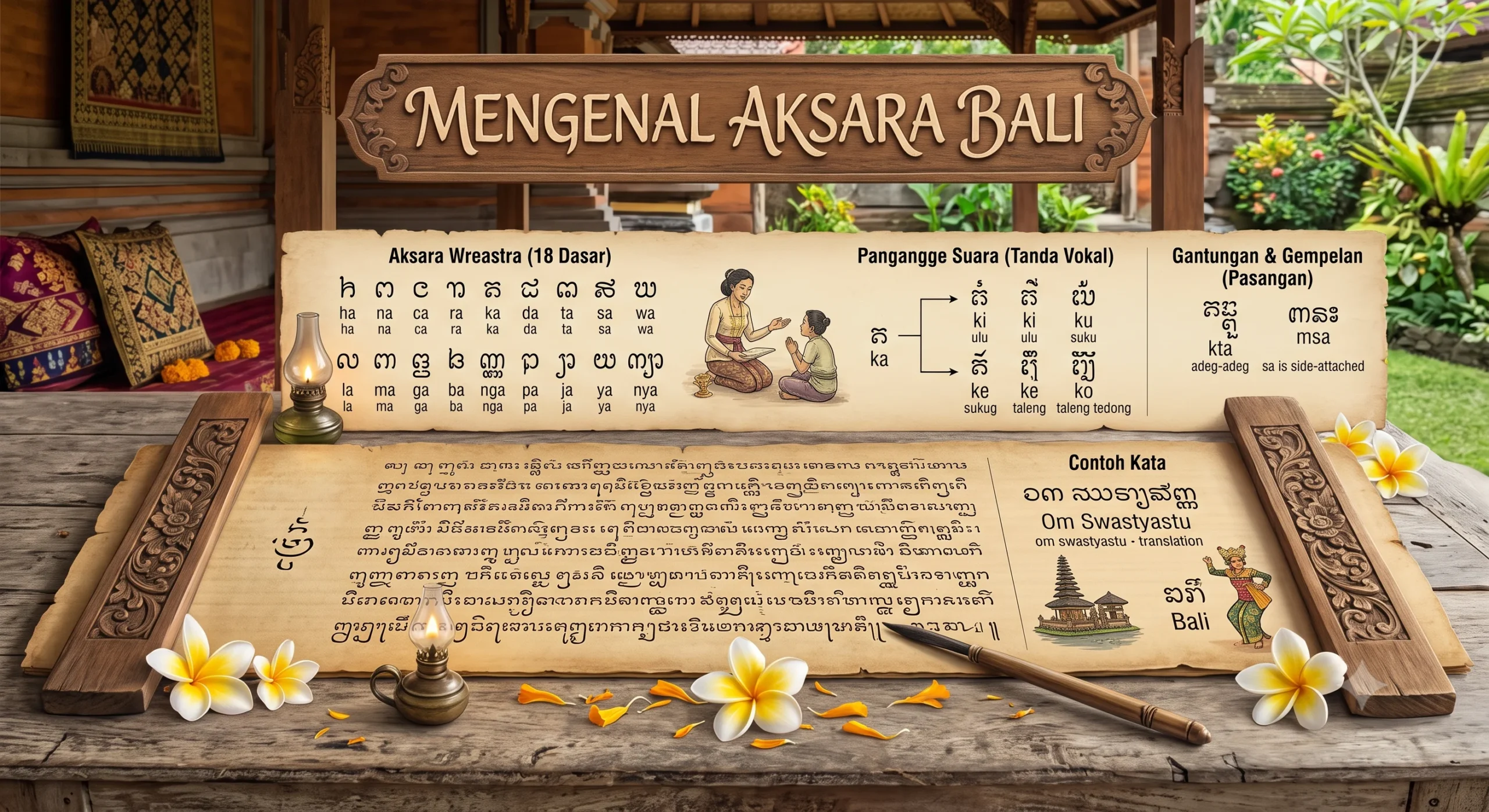
When visiting Bali, we may have seen unique curved writing on street signs, government offices, schools, temples, or tourist attractions. This writing is known as Balinese Script.
For the Balinese people, this script is not just a traditional form of writing. Balinese Script is an important part of language, culture, education, literature, and religious life. Through this script, various stories, knowledge, customary rules, historical records, and religious teachings are passed down from one generation to the next.
Although people now more often use the Latin alphabet in daily life, Balinese Script is still studied in schools and used in various cultural activities.
What Is Balinese Script?
Balinese Script is a traditional writing system used to write the Balinese language. This script can also be used to write Kawi or Old Javanese, Sanskrit, and in certain uses, the Sasak language.
Balinese Script is part of the same family as various traditional scripts in South Asia and Southeast Asia. Its development is related to the Brahmi script from India, then underwent adjustments in form and rules according to the language and culture of the Balinese people.
Unlike the Latin alphabet which usually represents one sound, one basic letter in Balinese Script generally already has the vowel sound “a”. For example, the script ᬓ is read as “ka”, not just “k”.
To change the sound “ka” to “ki”, “ku”, “ke”, or “ko”, additional marks called pangangge suara are needed.
Brief History of Balinese Script
There is no specific date indicating when Balinese Script first appeared. Its history is known through relics such as stone inscriptions, copper inscriptions, ancient manuscripts, and writings on palm leaves.
The development of script in Bali is related to the influence of scripts from India through trade, religious activities, culture, and political relations. The form of these scripts then developed into Kawi script or Old Nusantara script. Through this long journey, Balinese Script acquired its current form and rules.
In the past, Balinese Script was often written on palm leaves. Writers used a sharp tool called pangrupak to scratch the surface of the palm leaf. After finishing, the scratched parts were smeared with a black mixture, usually made from candlenut charcoal, so that the writing would be clearly visible.
Palm leaf manuscripts do not only contain stories. There are also those discussing traditional medicine, auspicious day calculations, family history, customary law, agriculture, architecture, religious ceremonies, and various other knowledge.
Basic Letters in Balinese Script
The most commonly used basic letters are called Aksara Wreastra. This script is also known as Aksara Hanacaraka or Aksara Wreastra Astapuluh because it consists of 18 basic letters.
Here is the order of the basic letters:
| Sound | Script | Sound | Script |
|---|---|---|---|
| Ha | ᬳ | Na | ᬦ |
| Ca | ᬘ | Ra | ᬭ |
| Ka | ᬓ | Ga | ᬕ |
| Ta | ᬢ | Ma | ᬫ |
| Nga | ᬗ | Ba | ᬩ |
| Sa | ᬲ | Wa | ᬯ |
| La | ᬮ | Pa | ᬧ |
| Da | ᬤ | Ja | ᬚ |
| Ya | ᬬ | Nya | ᬜ |
The order is often remembered through the arrangement:
Ha Na Ca Ra Ka, Ga Ta Ma Nga Ba, Sa Wa La, Pa Da, Ja Ya Nya.
These letters are sufficient to write many words in everyday Balinese. However, to write words derived from Kawi, Sanskrit, or other languages, additional letters are needed.
Aksara Suara or Vowel Letters
Aksara suara are letters used to write vowel sounds, especially when these sounds occur at the beginning of a word.
Some examples of aksara suara include:
| Vowel | Script |
|---|---|
| A | ᬅ |
| I | ᬇ |
| U | ᬉ |
| E | ᬏ |
| O | ᬑ |
Aksara suara are different from pangangge suara. Aksara suara can stand alone, while pangangge suara are attached to consonant letters to change their vowel sound.
Pangangge Suara
Each basic letter in Balinese Script has an inherent “a” sound. To change its vowel, pangangge suara are used.
An example can be seen with the script ᬓ or “ka”:
| Sound | Writing |
|---|---|
| Ka | ᬓ |
| Ki | ᬓᬶ |
| Ku | ᬓᬸ |
| Ke | ᬓᬾ |
| Ko | ᬓᭀ |
The mark for the sound “i” is called ulu, while the mark for the sound “u” is called suku. There is also taling for the sound “e” and taling tedung to form the sound “o”.
The placement of vowel marks is not always after the letter. Some marks are placed above, below, in front of, or behind the base script. Therefore, learning Balinese Script is not just about memorizing letter shapes, but also understanding the position of each mark.
Gantungan and Gempelan
In Balinese Script, two consonants sometimes meet without an intervening vowel sound. In such conditions, the second script is usually written in the form of gantungan or gempelan.
Gantungan is generally placed below the preceding script. Meanwhile, gempelan can attach to a specific part of the main script.
As an illustration, the word “bakti” has a meeting of the sounds “k” and “t”. The sound “ka” in that part is not fully read as “ka”, so the following script needs to be written using the appropriate paired form.
This system makes the writing of Balinese Script appear layered. There are scripts on the main line and those below it.
Adeg-adeg
Adeg-adeg is a mark used to remove the inherent vowel sound of a script.
For example, the script ᬓ is read as “ka”. After being given adeg-adeg, it becomes ᬓ᭄, and its sound changes to “k”.
Adeg-adeg is usually used when a consonant is at the end of a word or when the gantungan form cannot be used. In the dictionary of the Bali Provincial Language Center, adeg-adeg is explained as a mark to indicate a consonant at the final part in the Balinese Script system.
However, the use of adeg-adeg cannot be done carelessly. The writer must still follow the rules of script pairing.
Pangangge Tengenan
Pangangge tengenan are marks used to write certain consonant sounds at the end of a syllable.
Some frequently encountered marks include:
- Cecek for the sound “ng”
- Surang for the sound “r”
- Bisah for the sound “h”
- Adeg-adeg to silence the vowel sound of a script
For example, cecek can be used to write the sound “ng” at the end of a syllable without having to write the full script “nga”.
What Is Pasang Aksara Bali?
Pasang aksara are the rules for placing and using Balinese Script. Its function is similar to spelling in Latin script writing.
Pasang aksara governs various things, such as letter selection, use of gantungan, use of gempelan, placement of vowel marks, writing of final sounds, and how to write loanwords.
Therefore, converting Latin script to Balinese Script cannot always be done by replacing letters one by one. The writer must pay attention to the sound of the word, the origin of the word, and the writing rules. The Bali Provincial Government explains that pasang aksara are rules for placing Balinese letters according to agreed-upon principles.
For example, words from everyday Balinese may have different rules than words from Sanskrit or Kawi.
Types of Balinese Script Based on Usage
Generally, Balinese Script can be distinguished based on function and usage.
1. Aksara Wreastra
Aksara Wreastra is used to write Balinese for everyday needs. This script can be found in stories, letters, notes, agreements, and various general writings.
Aksara Wreastra consists of 18 basic letters as previously explained.
2. Aksara Swalalita
Aksara Swalalita has a more complete set of letters compared to Aksara Wreastra. This type is used to write Kawi, Sanskrit, kakawin, parwa, kidung, tutur, wariga, and various traditional literary works.
Aksara Swalalita includes basic letters, vowel letters, and several additional letters representing specific sounds.
3. Aksara Modre
Aksara Modre is more often used in religious and spiritual activities. This script can be found in rerajahan, ceremonial tools, and certain manuscripts.
Aksara Modre not only functions as writing that is read normally. In Balinese culture, its form can also be a symbol with religious meaning. Due to its special nature, its writing and use should be done by those who understand the rules and meanings.
Numbers in Balinese Script
Balinese Script also has its own number symbols.
| Number | Balinese Script |
|---|---|
| 0 | ᭐ |
| 1 | ᭑ |
| 2 | ᭒ |
| 3 | ᭓ |
| 4 | ᭔ |
| 5 | ᭕ |
| 6 | ᭖ |
| 7 | ᭗ |
| 8 | ᭘ |
| 9 | ᭙ |
These numbers can be used to write dates, quantities, numbers, and various other numerical forms.
When writing numbers in the middle of a sentence, a separator mark is usually needed so that numbers are not confused with regular scripts. This is important because some number shapes resemble certain letters.
Punctuation in Balinese Script
Balinese Script has traditional punctuation called carik.
Some commonly known marks include:
- Carik siki, functions similarly to a comma
- Carik kalih, functions similarly to a period
- Panten or pasalinan, used as a mark for section changes
- Pamada, used at the beginning of certain writings
Their usage can differ depending on the type of manuscript and context of the writing. In traditional manuscripts, punctuation can also function to regulate pauses when the text is read or chanted.
Examples of Simple Word Writing
Here are some simple examples:
Bali
ᬩᬮᬶ
This word consists of the script “ba”, the script “la”, and the ulu mark on the script “la” to produce the sound “li”.
Buku
ᬩᬸᬓᬸ
The suku mark is used on the scripts “ba” and “ka” so their sounds change to “bu” and “ku”.
Suka
ᬲᬸᬓ
The script “sa” is given the suku mark to become “su”, then followed by the script “ka”.
These examples still use simple words. For words with consecutive consonants, final sounds, or from other languages, the writing rules can become more complex.
How to Write Balinese Script
Generally, Balinese Script is written from left to right. There are several media that can be used to write it.
Writing on Palm Leaves
On palm leaves, the script is scratched using a pangrupak. The writer must be careful because mistakes cannot be erased like pencil writing.
After all the writing is scratched, the surface is smeared with a black substance to make the script more visible.
Writing on Paper
Beginners can use a pencil so that writing can be easily corrected. After becoming more accustomed, writing can be done using a pen.
To produce a beautiful form, hand pressure can be adjusted. Some lines are made thin and some parts are made thicker. This method gives a smooth and artistic impression to the writing.
Writing Digitally
Now Balinese Script can also be typed using computers and smartphones. Balinese Script is available in the Unicode standard in the character range U+1B00 to U+1B7F. This allows the script to be used in documents, websites, applications, and social media as long as the device and font support it.
The display of Balinese Script sometimes differs on each device. On devices that do not support Balinese Script fonts, the writing may appear as empty boxes or the arrangement may look incorrect.
Why Is Balinese Script Important to Preserve?
Balinese Script holds much knowledge about the life of the Balinese people. Various palm leaf manuscripts contain information on history, literature, religion, traditional medicine, calendar calculations, and social life.
If the younger generation can no longer read it, some of that knowledge will become increasingly difficult to understand.
Preserving Balinese Script does not mean everyone must immediately become an expert. Small steps such as recognizing basic letters, learning to write one’s own name, reading street signs in Balinese Script, or trying to type Balinese Script digitally are already forms of care.
The Bali Provincial Government also provides protection through Bali Provincial Regulation Number 1 of 2018 and Bali Governor Regulation Number 80 of 2018 concerning the protection and use of Balinese language, script, and literature.
Tips for Learning Balinese Script for Beginners
Learning Balinese Script will feel easier if done step by step. Start by memorizing a few basic letters, then try writing simple syllables like “ka”, “ba”, “ma”, and “sa”.
After that, learn pangangge suara to change the sound “a” to “i”, “u”, “e”, or “o”. Once comfortable, continue with gantungan, gempelan, pangangge tengenan, and the rules of pasang aksara.
Don’t just memorize shapes. Try writing commonly used words, place names, or your own name. Short, regular practice is usually more effective than memorizing many letters at once.
For writing that will be used on street signs, logos, tattoos, official documents, or religious tools, it is best to have the result checked by someone who truly understands pasang aksara. Small mistakes in the use of marks or gantungan can change the reading and meaning of the writing.
Conclusion
Balinese Script is one of the cultural heritages that shows the richness of the Balinese language and knowledge. Its beauty is not only seen in the curved letter shapes but also in the writing rules and cultural values contained within.
This script is used to write everyday language, literary works, traditional knowledge, historical records, and religious needs. Although it may seem complicated at first, Balinese Script can be learned little by little, starting from recognizing basic letters, vowel marks, pairs, to the rules of pasang aksara.
In the midst of technological development, Balinese Script does not have to be stored only in palm leaves or old books. This script can also appear in applications, websites, information boards, design works, and digital communication. By continuing to learn and use it correctly, Balinese Script can remain alive and be known by future generations.